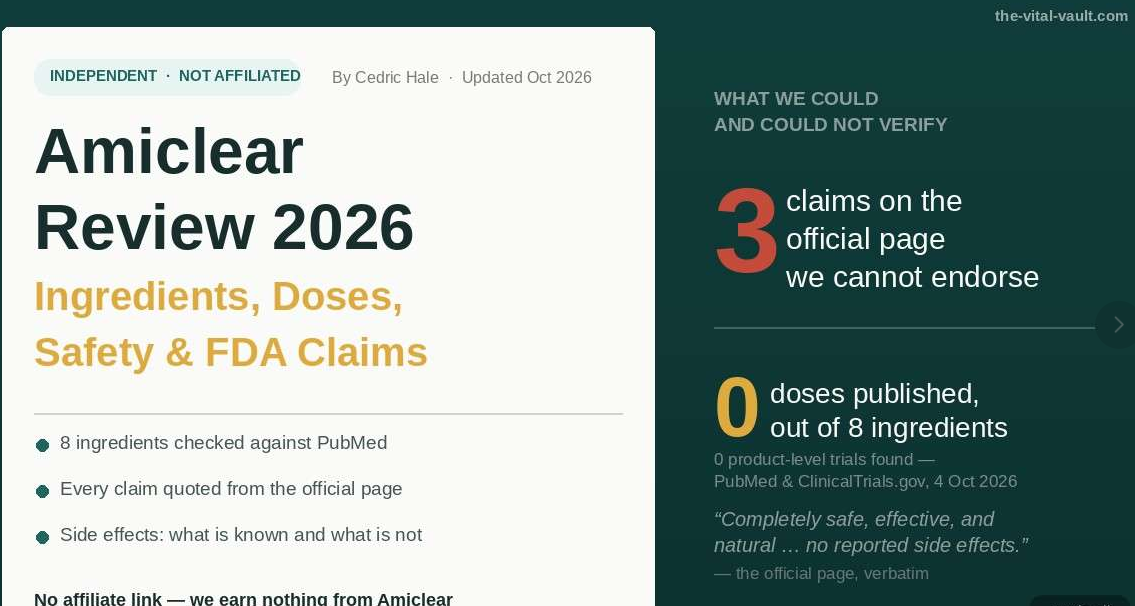
Last updated: October 2026
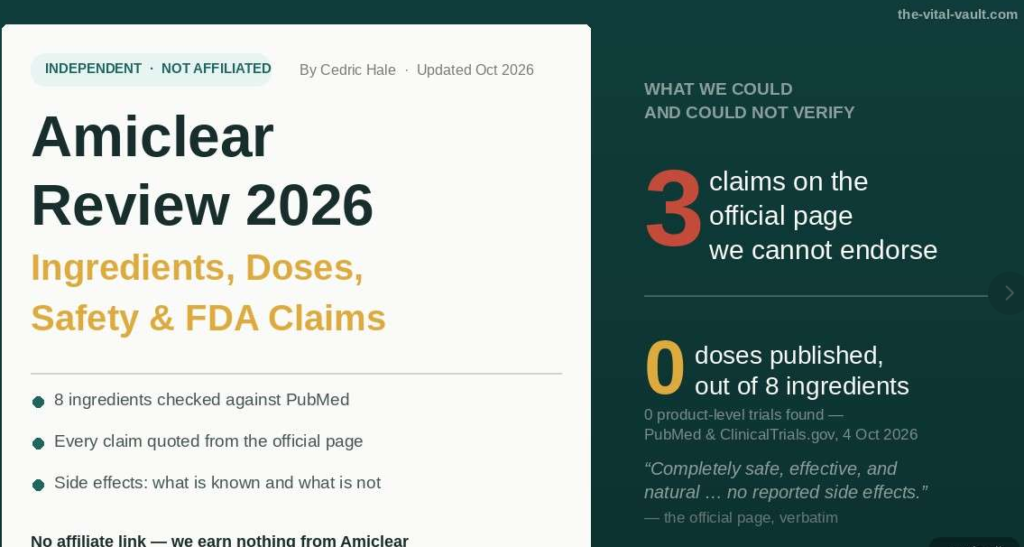
Disclosure: We are not an affiliate for Amiclear. There is no link to buy it anywhere in this article, and we earn nothing if you do. We reviewed it because it appears in our comparison of five blood sugar supplements, where it placed fifth — and this article explains exactly why.
Amiclear is a liquid blood sugar supplement sold from amiclear.org. Its own marketing page makes several specific claims about what it does, who it is for, and how it is regulated. This article takes those claims one at a time and reports what we found when we checked them.
That is a narrower job than a typical supplement review, and we want to be clear about what this article is and is not. It is not a product recommendation. We are not going to tell you whether to buy Amiclear, because we cannot verify the things that would make that judgement possible — most importantly, how much of each ingredient a dose actually contains. What we can do is check whether the statements on the official page hold up, and tell you plainly when they do not.
Table of Contents
How We Checked This Product
Because this article is a verification exercise rather than an opinion piece, here is the method behind it, so you can judge the findings accordingly.
- Product page. We loaded amiclear.org in a real browser and read the rendered page, including the collapsed FAQ panels, rather than relying on a text extract that would miss them. We captured the page twice, on 25 September and 3 October 2026, to confirm the wording had not changed between reads. The quotes in this article are reproduced verbatim from those captures.
- Ingredient list. We treated the site’s own list as the definition of the formula, and where the site names an ingredient only in passing elsewhere on the page, we say so explicitly rather than merging the two.
- Dose search. We manually reviewed the product page and its available ingredient information for individual ingredient quantities, extract standardisation, serving size, and proportions. We also searched for quantities expressed in mg, mcg, grams, percentages, and other relevant units. We then separated three findings that are often merged: whether any per-ingredient amount is published; whether the proportions between ingredients are published; and whether the total weight of the proprietary blend per serving is published. These are three different disclosures, and we report each separately below.
- Ingredient research. We searched PubMed, most recently on 4 October 2026, for each named ingredient combined with glucose-related terms — for example “Gymnema sylvestre” with blood glucose, and “Irvingia gabonensis” with metabolism. We distinguish throughout between randomised human trials, observational human studies, animal work, and cell studies. Where a trial exists but its result was null, we report the null result rather than only the fact that a trial exists. Search results were checked against the full scientific name, because a common name in PubMed also returns studies on related but different species.
- Product-level research. We also searched PubMed for the product name “Amiclear” and searched ClinicalTrials.gov for the same term, both on 4 October 2026. Neither returned any record. We report this as a search result rather than as proof that no product-level study exists, because an unregistered or unpublished study would not appear in either database.
- Regulatory claims. We checked statements about the FDA against the FDA’s own published guidance rather than against other supplement sites.
- Domain check. We checked the other domains carrying this brand name to see where they lead.
Two limits apply to everything below. We worked from the website, not from a physical bottle — a label printed on packaging is not something we can see from here, and we say so where it matters. And we have not been medically reviewed; see the note at the end of this article.
What Amiclear Is: The Basics
The product is a liquid, not a capsule. Each bottle contains 60 ml, and the instruction on the page is to place the required amount under your tongue with a dropper, or to dissolve it in water and swallow it, once daily before breakfast.
The website describes a dropper-based daily serving but does not provide a clearly verifiable volume per serving in the information we reviewed. The page says to pour “the necessary quantity” onto the dropper, without stating how many millilitres or how many drops that is. This makes it difficult to assess the amount of the formula consumed each day — and because no ingredient amount is published either, the daily intake of any individual ingredient cannot be established from the website at all.
What the Official Page Charges and Promises
| Item | What the official page states |
|---|---|
| Format | Liquid drops, 60 ml per bottle, taken once daily before breakfast |
| Headline price | $49 per bottle |
| Multi-bottle pricing | Not shown on the main page — reached at checkout |
| Refund window | 60 days, stated as a “100% money-back guarantee” |
| Refund conditions | Two published statements give different conditions — one covers an empty bottle, one involves returning what you have not used. See below. |
| Manufacturing | “Made in the USA”, described as an FDA-registered, GMP-certified facility in one place and an “FDA-approved” facility in another |
| Bonuses | Two bonus eBooks with 3- and 6-bottle purchases |
| Ingredient amounts | Not published anywhere on the site — described only as a “proprietary blend” |
The ingredient amounts are the row that matters most. Every other line on that table is a published commitment you could hold the company to. The amounts are the one thing that is not — and as the next section explains, they are the thing that decides whether any of the ingredient research means anything for this product.
On the refund terms, the page says two different things, and the difference is the part a buyer actually needs. The 60-day window is genuinely customer-friendly, and the guarantee is mentioned in several places on the page. We are going to quote only the two places that state actual refund conditions, because those are the ones we can show you in full. The first carries the stronger wording, in language that explicitly covers an empty bottle:
“Just contact us in the first 60 days from your purchase, even if you used up the entire bottle or not, we would still give you your money back.”
And in the FAQ, under “What If Amiclear Doesn’t Work For Me?”, a second version appears:
“If for any reason you’re unsatisfied with your results, you can just return what you haven’t used for a full, no questions asked refund.”
That second sentence is a returns condition: it describes sending back the unused portion. The first sentence says the opposite — that an empty bottle is still refundable. Both appear on the same site, in different parts of the same page, and they cannot both describe the same process. We are not going to resolve which one applies in practice, because that is between the buyer and the seller, and the answer may depend on the payment processor’s own terms. What we will say is that if you are relying on the empty-bottle version, get it in writing from support before you buy, and keep the email. That is a five-minute step that turns an ambiguity into a record.
The Ingredient List, Fully Reviewed
The page describes its formula as “a bespoke proprietary formula of 8 special high-quality natural ingredients and plant extracts,” and then names eight. Here they are with what the official site claims for each, and what independent human research actually shows.
A note on the list you are about to read, because the ninth name causes real confusion. Copper is not one of the eight. It does not appear in the ingredient entries at all. It appears once on the page, in a general sentence that also mentions grape seeds:
“Amiclear ingredients like copper and grape seeds are useful for the management of blood sugar and cardiac health.”
We have seen third-party reviews present copper as an Amiclear ingredient, which is understandable — the sentence names it as an ingredient — but it is not in the company’s own eight-item list, and the page gives no quantity for it anywhere. We are treating it as a passing mention rather than a formula component, and where we discuss it below, we label it as such. If you find copper printed on a physical bottle label, that would settle the question, and we would update this article.
Gymnema Sylvestre — The Strongest Ingredient Here
The page describes it as a remedy for sugar cravings, notes the gymnemic acid content, and mentions the Hindi name “Gurmar,” meaning “sugar destroyer.” That is accurate naming — Gymnema is genuinely known by that name, and the gymnemic acid is the reason.
Among the listed ingredients, Gymnema has some of the more directly relevant human research on glucose-related outcomes. A small trial in 22 people with non-insulin-dependent diabetes tested a specific Gymnema extract at 400 mg/day for 18–20 months alongside their existing oral glucose-lowering medication, and reported reductions in blood glucose and glycated haemoglobin; five of the 22 were able to stop their conventional medication and maintain glucose control on the extract alone (PubMed). More recent work has examined its effect on sweet-food motivation and sugar intake, which is a separate question from glucose control but relevant to why people take it (PubMed). However, the available trials are limited, and their findings cannot establish the effectiveness of Amiclear itself.
What this does and does not tell you. The Gymnema research base is real but small, and it was conducted using specific standardised extracts at specific doses. Nothing in that literature tells you whether the Gymnema in a 60 ml bottle of Amiclear is at the amount any of those trials used. We will come back to this point, because it is the central problem with this product.
Ginseng — Real Research, Wrong Species Risk
The page states that ginseng “boosts insulin production” and can help with diabetes treatment. That is a confident claim about a mechanism, and the mechanism itself has been studied. American ginseng has been shown to reduce post-meal glucose in both non-diabetic and diabetic participants in a controlled study (PubMed). A separate randomised trial examined a red ginseng extract for glycaemic control (PubMed).
Here is the problem. “Ginseng” is not one plant. American ginseng (Panax quinquefolius), Asian ginseng (Panax ginseng), and Korean red ginseng are different species with different ginsenoside profiles, and the studies above used specific ones. The Amiclear page says only “Ginseng.” It does not name the species, the extract, or the amount. A claim that rests on a specific studied extract cannot be transferred to an unnamed ingredient.
Two limits on that research are worth stating, because they affect how far it travels. The American ginseng study was small and short-term: 10 non-diabetic participants and 9 with type 2 diabetes, given 3 g of a specific American ginseng before or with a glucose challenge, and it measured post-meal glucose rather than long-term glycaemic control (PubMed). The red ginseng trial involved 98 adults with prediabetes over 12 weeks, using a specific red ginseng extract powder at 1,000 mg/day (PubMed). That trial also has a limitation worth knowing about: the first author’s affiliation was the Korea Ginseng Corporation Research Institute, and the product tested was made by that company. This does not invalidate the findings, but it is relevant context when assessing the independence of the evidence. Neither study can be combined into a claim about an ingredient the page identifies only as “Ginseng.”
African Mango (Irvingia gabonensis) — The Site Names Its Own Weak Link
This is where the Amiclear page does something rare and, in our view, creditable. Right in the middle of the African Mango entry, it volunteers this:
“While maca root and guarana have few studies confirming their blood sugar effects, African mango extract does have evidence of its blood sugar supporting effects.”
A supplement page admitting that two of its own headline ingredients lack evidence for the effect the product is sold for is, in our reading of the page, an unusually candid concession for a product in this category.
On African Mango itself, the picture is more limited than that sentence suggests. A 2022 randomised, placebo-controlled study gave 300 mg of Irvingia gabonensis kernel extract or a placebo daily for 12 weeks to overweight and obese individuals (PubMed). The extract raised plasma vitamin C and adiponectin — but the study reported no differences between the supplement and placebo groups in metabolism, inflammation, or body-composition outcomes, and blood sugar was not among the primary measures at all. A comprehensive 2024 review of the plant covers its traditional use and therapeutic potential, and it is explicit that much of the evidence remains preclinical (PubMed). So the site is directionally right that African Mango has been studied — but the trial found no significant between-group differences in the measured metabolism, inflammation, body-composition, and related outcomes, although some individual biomarkers changed. It was not a blood-sugar trial. (A detail on that trial: it was funded by Blackmores Limited, a supplement manufacturer, which stated it had no role in the study design, analysis, or reporting.)
Maca Root, Guarana, Astragalus, Coleus, Grape Seed
The remaining named ingredients are listed with supportive language — maca for iron and iodine, guarana as an “herbal remedy” that may “improve blood sugar control,” astragalus for immunity and diabetes, coleus for heart and respiratory conditions, and grape seed for blood pressure and circulation.
None of these claims is backed by a citation, and the site’s own sentence above concedes the point for maca and guarana. When we searched the literature for these ingredients specifically in relation to blood glucose, what came up was mostly animal work, cell studies, and research on unrelated outcomes — male reproductive health for maca, athletic performance for guarana, wound healing and diabetic complications for astragalus. A caution for anyone doing this search themselves: “maca” in PubMed also returns studies on Lepidium sativum, a different plant, so results have to be checked against the species name. Grape seed extract has been studied in human cardiovascular and metabolic research. One small randomised trial involving 50 patients with non-alcoholic fatty liver disease examined 520 mg/day of grape seed extract over two months and reported changes in insulin and insulin-resistance markers, including HOMA-IR and QUICKI (PubMed). However, this was not a clinical trial establishing that grape seed extract treats diabetes or reliably controls blood glucose in people with diabetes. The findings are limited by the small study population, short duration, and specific patient group — and the page’s claim is about circulation and blood pressure anyway.
Copper — Mentioned Once, Not Listed as an Ingredient
The page says copper is beneficial for blood sugar and heart health, in the single sentence quoted at the top of this section. Because copper is the one name here that readers most often assume is a listed ingredient, it is worth stating what the evidence does and does not support.
We searched specifically for randomised human trials of copper supplementation measuring blood glucose. We did not identify a relevant randomised human trial in our search — the human literature on copper supplementation concerns deficiency, immune function, and cardiovascular markers, not glycaemic outcomes. The studies that do connect copper with blood sugar are observational, and they measure something different from what the page implies. For example, a 2021 meta-analysis looked at circulating copper levels in people with gestational diabetes and reported an association between copper status and risk (PubMed). An association between two measured values is not the same as evidence that taking extra copper changes anyone’s glucose. There is established research on copper deficiency and glucose metabolism, and that is the closest link we could find. The official page offers no reference for its copper sentence, and our search did not surface an intervention study supporting it either.
One distinction runs through everything above, and it is the most important sentence in this article. Evidence for an individual ingredient does not establish the effectiveness or safety of the finished product. Without verified ingredient amounts, extract specifications, and product-level clinical testing, the research discussed here cannot confirm that Amiclear produces the same effects. A study of Gymnema, American ginseng, or grape seed extract does not demonstrate that Amiclear itself has the same effects — that conclusion would require the actual formulation, the ingredient quantities, the extract specifications, and ideally controlled clinical research on the finished product. We have not presented ingredient studies as proof that Amiclear works, and no study cited in this section tested Amiclear.
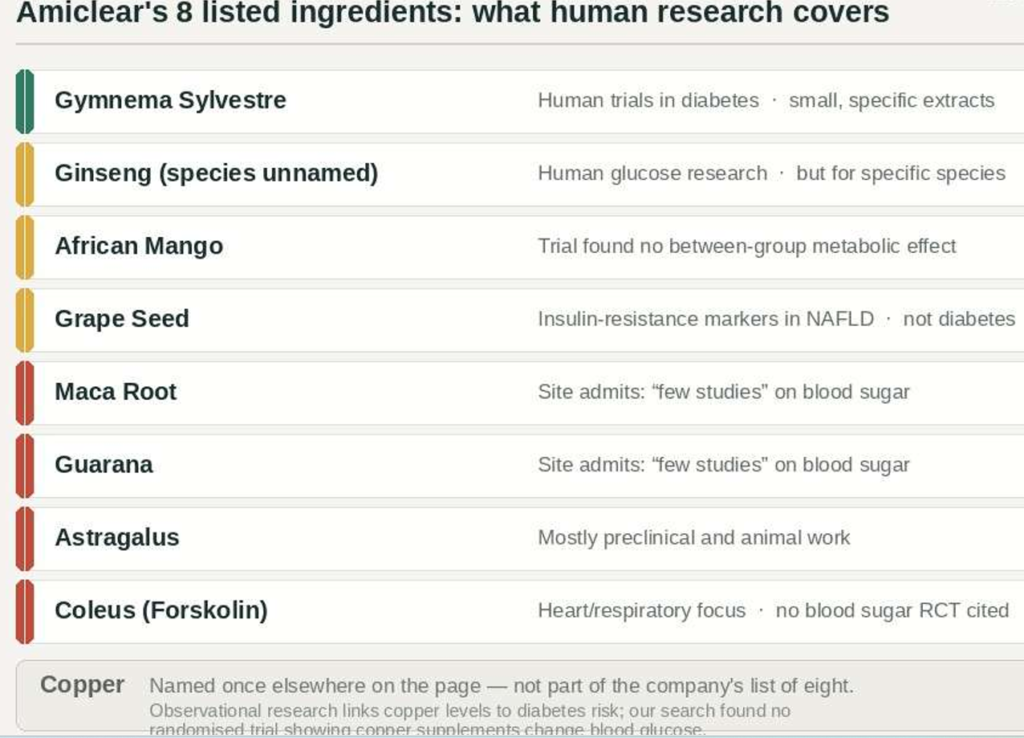
The honest summary of the ingredient list, revisited ingredient by ingredient: of the eight names in the company’s own list, one (Gymnema) has direct human blood-sugar research; one (ginseng) has human glucose research but under a species the page does not specify; one (African Mango) has a relevant human trial that found no metabolic effect over placebo; one (grape seed) has small human trials reporting changes in insulin and insulin-resistance markers, in patients with a liver condition rather than in diabetes; and the rest — maca, guarana, astragalus, and coleus — have no human blood-sugar research we could find, a point the page itself concedes for two of them. Copper sits outside that list as a passing mention with no human intervention evidence behind it. For a formula sold specifically for blood sugar, that is a thin evidence base spread across a large list.
The Dose Problem: Why None of the Above Settles Anything
Everything in the section you just read comes with the same caveat, and it is not a small one.
When we reviewed the Amiclear page and its ingredient information for published quantities — searching for amounts expressed in mg, mcg, grams, and percentages — we found none. The formula is described as a “proprietary blend,” which is a legal way to list ingredients without disclosing proportions. Three separate things are missing here, and they are worth keeping apart: no per-ingredient amount is published, so you cannot compare any ingredient against the dose used in a study; no proportions between ingredients are published, so you cannot tell what the formula is mostly made of; and no total weight for the blend per serving is published, so you cannot derive the first two from the third. The company’s own page concedes the consequence, in a sentence it may not have intended as a concession:
“Thus, the substances utilized in Amiclear are extremely nice, but we can’t say for definite that it will be fantastic since we don’t know how much of each ingredient is used in the supplement.”
That sentence is worth reading twice. It is the seller telling you that the dose information needed to evaluate the formula is not available — and it is the same limitation this article runs into.
Dose matters more than it might sound. The Gymnema trial used a standardised extract at a defined strength. In this category generally — berberine being the best-documented example, though it is not in this formula — the human evidence comes from daily intakes in the hundreds of milligrams. Chromium’s comes from a specified range in micrograms. A dose is what turns an ingredient from a name on a label into a quantity that has been tested. Without it, you cannot tell whether a serving of Amiclear contains the amount used in any study that has ever been run — or a fraction of it.
We are reporting the absence of published amounts, not a proved fact about what is in the bottle. A brand may print quantities on the physical label that its website omits, and we cannot rule that out from here. But the website is where the product is sold and where the claims are made, and it is the only version of the label a buyer online can check before paying.
This is not unique to Amiclear. In our comparison of five blood sugar supplements, we recorded missing dose information across all five products. Amiclear is one entry in that pattern — it is the product where the dose gap sits alongside the specific statements the next section takes up.
Three Claims on the Official Page We Can’t Endorse
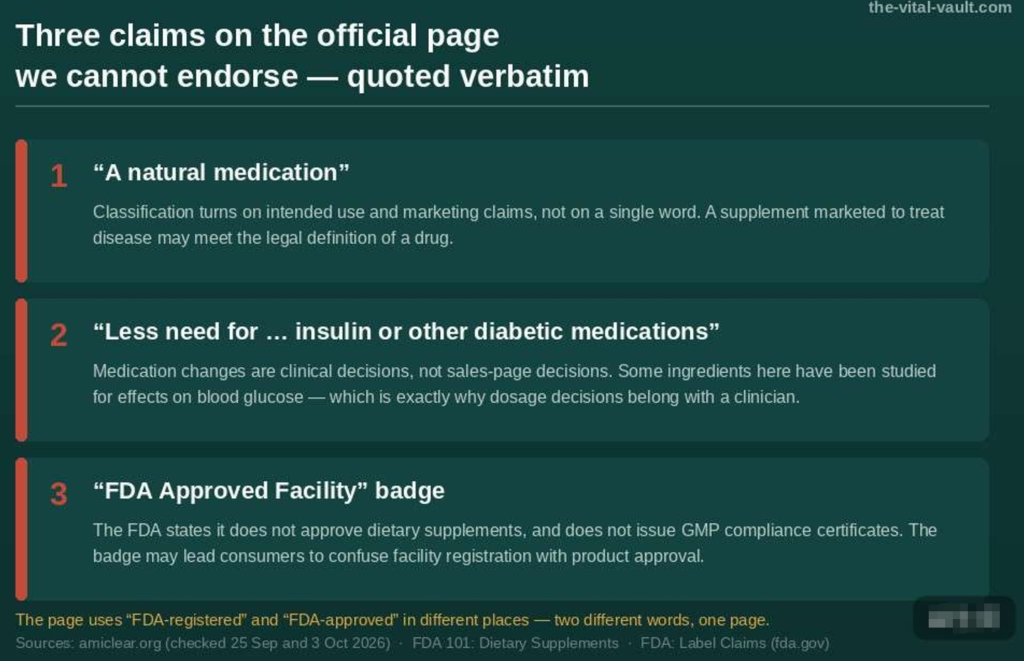
These are not our interpretations. They are sentences that appear on amiclear.org, quoted verbatim, alongside what we found when we checked them.
1. The page calls the supplement a “medication”
Among the listed advantages, the page states:
“Amiclear Drop is a natural medication that helps to regulate blood glucose levels.”
The page header labels the product “Dietary Supplement.” Those two descriptions are not interchangeable, and this is the point where the marketing stops being loose language and becomes a legal category question. Under US law a dietary supplement is regulated as a category of food, not as a drug. A product intended to diagnose, cure, mitigate, treat, or prevent disease may fall under the legal definition of a drug. Drugs generally require FDA approval before marketing, based on applicable evidence of safety and effectiveness for their intended uses. Dietary supplements, by contrast, generally do not undergo the same premarket approval process. A supplement is also not permitted to be marketed as though it had been through one.
The word “medication” is not, by itself, enough to determine a product’s legal classification. The more important issue is the product’s intended use and the claims made in its marketing. Under US law, a product marketed as a dietary supplement but intended to treat, prevent, or cure a disease may meet the legal definition of a drug. Such products are subject to the applicable drug requirements, rather than being treated as ordinary dietary supplements. FDA’s own consumer guidance confirms this boundary, and the quote is in the third item below.
2. The page suggests you may need less prescribed medication
Further down the list of advantages, the page states:
“There is less need for you to take large amounts of insulin or other diabetic medications.”
This is one of the most serious statements on the page. It is also relevant to our broader comparison of five blood sugar supplements, where we explain the specific transparency and marketing concerns associated with each product. It is written as though it follows automatically from taking a supplement. It does not.
If you use insulin or any glucose-lowering prescription medication, the amount you take is a clinical decision that depends on your blood glucose readings, your other medications, and your overall health. It is not something to change because a sales page mentions it. Some of the ingredients discussed in this article have been studied for effects on blood glucose — which is exactly why decisions about medication belong with the clinician who prescribed it, not with a supplement label.
There is a specific safety point here, and it is not theoretical. Insulin and sulfonylureas are medicines that lower blood glucose, and their dose is matched to what you eat and to your readings. If you reduce or stop one of them while believing a supplement is covering the difference, the risk is a hyperglycaemic episode — which is the outcome the medication was prescribed to prevent. If you add a supplement on top of a full dose and something in it does affect glucose, the risk runs the other way, toward hypoglycaemia: sweating, shaking, confusion, and in serious cases loss of consciousness. Neither scenario is something a marketing page is in a position to assess. If you are on insulin, any of the sulfonylureas (glipizide, glimepiride, glyburide), or a similar glucose-lowering medicine, talk to the prescriber before you start this or any supplement, and do not use a supplement as a reason to alter a prescribed dose.
We are not suggesting the company is telling readers to stop their medication. We are pointing out that the sentence is written so that a reader could easily take it that way, and that in this particular category that is a dangerous thing to leave ambiguous.
There is also a narrower interaction point worth knowing about, because it runs through the ingredient list. Having been studied for effects on blood glucose is not the same thing as having a demonstrated clinical interaction with a glucose-lowering medicine, so here is what each case actually rests on. Gymnema has the clearest signal: a published risk assessment concluded that some Gymnema extracts may enhance the glucose-lowering effect of some antidiabetic drugs (PubMed). Ginseng has human glucose research, but it comes from specific species and specific extracts — American ginseng, and one particular red ginseng extract powder — and results from one cannot be transferred to an ingredient the page identifies only as “Ginseng.” Guarana contains caffeine, and caffeine can affect glucose readings and blood pressure in some people, independently of any glucose-lowering medicine. For the remaining named ingredients — maca, astragalus, coleus, grape seed — the available information is not sufficient to characterise an interaction risk in this formula, so we are not going to describe one. We set out the full reasoning, including what is and is not documented, in Amiclear Side Effects and Safety Claims below. If you take a glucose-lowering medicine, bring the ingredient list to your pharmacist and ask the question directly. That is a free conversation and it takes five minutes.
3. The “FDA Approved Facility” badge
The page displays a badge reading “FDA Approved Facility,” and its FAQ list includes the question “Is Amiclear Approved By The FDA?” The answer given in that FAQ is: “Amiclear is manufactured in the USA by our FDA-approved, GMP-certified facility.” The phrase “FDA-approved” also appears in the FAQ describing the product’s safety, so this is not a one-off slip — it is the page’s standard way of describing its manufacturing. The page uses both terms, and not in the same place: “FDA-registered” appears in the advantages list, while “FDA-approved” appears in the badge, in the “Is Amiclear Approved By The FDA?” answer, and in the “Is Amiclear Safe?” answer. Those are different words with different meanings, used on the same page.
Here is what the FDA itself says about this:
“The FDA does NOT have the authority to approve dietary supplements for safety and effectiveness, or to approve their labeling, before the supplements are sold to the public.” — FDA 101: Dietary Supplements
What does exist is facility registration: a company that manufactures supplements can register its facility with the FDA and follow good manufacturing practice. The Amiclear page describes exactly that in its advantages list, where it says the product is made in “an FDA-registered, GMP-certified facility.” Facility registration and GMP compliance are two separate matters. FDA registration does not mean that the agency has approved or certified a manufacturing facility. Similarly, FDA does not issue certificates confirming that a dietary supplement manufacturer is GMP-compliant. If a company describes its facility as “GMP-certified,” the identity of the certifying organization and the underlying certificate should be independently verified.
The distinction has a legal edge, so it is worth stating in the FDA’s own terms. Registration is a filing requirement for a facility: the company tells the FDA where the product is made. Approval is an evaluation of a product against evidence of safety and effectiveness. The FDA does not approve dietary supplements — not their safety, not their effectiveness, and not their labels — which is the sentence quoted above. FDA’s labelling guidance states the same boundary from the other direction, describing the claims supplement makers are allowed to make as “not pre-approved by FDA,” with the manufacturer — not the agency — responsible for holding substantiation that a claim is truthful and not misleading (FDA: Label Claims for Conventional Foods and Dietary Supplements).
That is the specific issue with the badge: not that the facility is unregistered, but that it uses the term “FDA Approved” in a way that may lead consumers to confuse facility registration with product approval. These are two different regulatory concepts, and the distinction matters when readers are assessing how much confidence to place in the badge.
To its credit, the same page carries a standard disclaimer at the bottom stating that “the FDA hasn’t evaluated the statements provided on this page.” That disclaimer is correct, and it sits several thousand words below the badge. We are not suggesting the disclaimer cancels the problem described above: a correct statement at the bottom of a page does not change the impression created by a badge near the top. Both are on the same page, and we are reporting both.
Amiclear Side Effects and Safety Claims
This article’s title promises a section on side effects, so here it is. The honest version has two halves, and the line between them is the most important thing in it: what is known about these ingredients, and what can be known about this product.
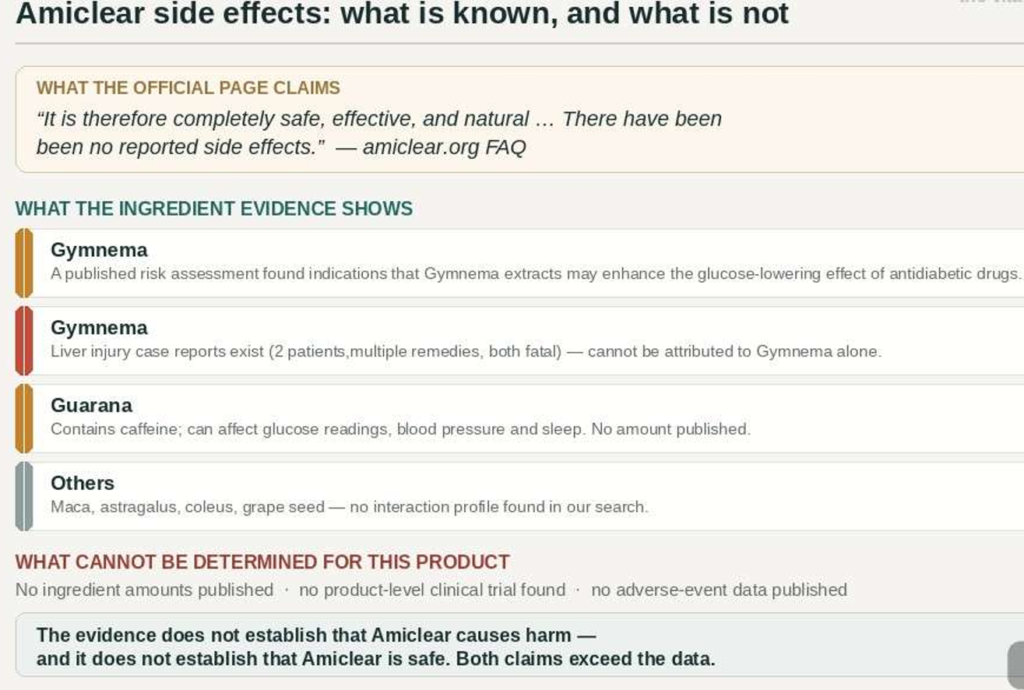
What the official page claims about safety
In the FAQ, under “Is Amiclear Safe?”, the page states:
“Amiclear contains 100% natural and safe ingredients. It is therefore completely safe, effective, and natural. Amiclear is used daily by thousands of people. There have been no reported side effects.”
That is a strong claim, and it is worth taking apart. “There have been no reported side effects” is a statement about data the company holds. The page does not publish that data, does not describe how reports would be collected, and provides nothing a reader could independently check. A supplement sold direct to consumers is not required to operate a public adverse-event reporting system of the kind that exists for prescription medicines. The sentence may well reflect what the company has received. As written, it presents an internal record nobody can verify as an established fact.
“Completely safe, effective, and natural” puts three different claims into one sentence. “Natural” says nothing about safety — many natural substances are pharmacologically active, and that activity is exactly what makes both effects and side effects possible. “Effective” is the claim the rest of this article has been unable to check, because no dose is published and no product-level trial exists. And “completely safe” is not a claim any manufacturer is positioned to make about a product with no published clinical safety data.
In fairness to the page, the same FAQ answer also says: “Before using, consult your doctor if you have any medical conditions.” We are not going to leave that out. But it appears after the safety claim, rather than qualifying it.
What is documented about the ingredients
The ingredients have been studied independently of this product, so more can be said about them than about Amiclear itself. Everything in this subsection is ingredient-level information.
- Gymnema sylvestre — the clearest documented concern. A 2018 risk assessment of Gymnema sylvestre published in the EFSA Journal concluded that human studies “provided some indications that certain Gymnema extracts may enhance the glucose-lowering effects of certain antidiabetic drugs,” and that given the uncertainties about composition and potential herb–drug interactions, the use of Gymnema-based supplements alongside authorised antidiabetic medicines “may be associated with risks” (PubMed). The same assessment noted that the limited toxicological and human evidence available suggested “lack of relevant adverse effects” of the botanical. So this is a precaution about a specific combination — Gymnema taken together with a prescribed glucose-lowering medicine — not evidence that Gymnema is harmful in general.
- Gymnema and reported liver injury. Published case reports exist. A 2022 BMJ Case Reports paper described two patients who developed hepatitis-associated aplastic anaemia after taking ayurvedic herbal and homeopathic remedies, with Gymnema sylvestre named among the products involved; both patients died (PubMed). Two things limit what that report can establish: both patients were taking more than one remedy, so the injury cannot be attributed to Gymnema alone; and two cases cannot establish a causal relationship in any event. What it does establish is that severe liver reactions have been reported in connection with products of this kind. Separately, a 2024 laboratory study found that Gymnema sylvestre extract strongly reduced the viability of human liver cells in culture, while Coleus forskohlii extract — coleus is also named in this formula — induced CYP3A4, an enzyme involved in drug metabolism (PubMed). Cell-culture and animal findings are not human outcomes. They are a reason to take the question seriously, not evidence of harm in people.
- Ginseng. The human research involves specific species and specific extracts, and the findings do not transfer between them — see the ingredient section above. That limitation applies to interpreting any effect, wanted or unwanted.
- Guarana. Guarana seed contains caffeine. Caffeine can affect blood glucose readings and blood pressure in some people, and it can disturb sleep, which itself affects glucose management. The page publishes no caffeine amount, so there is no way to tell what a serving delivers.
- Maca, astragalus, coleus, grape seed. We did not find published interaction profiles with glucose-lowering medicines for these ingredients, so we are not going to describe one. That is an absence of findings in our search, not a finding of absence.
What cannot be determined about Amiclear itself
Everything above concerns ingredients, not this product. That distinction decides what can honestly be said here.
We did not find a clinical trial of Amiclear as a finished product. A PubMed search for the product name returned no records, and a ClinicalTrials.gov search returned no registered studies. That is a search result, not proof that no study exists — an unregistered or unpublished study would appear in neither database. But it does mean there is no published product-level safety or efficacy data we can point to.
Without that, and without published ingredient amounts, three things cannot be determined:
- Whether the formula contains any ingredient at a level comparable to the amounts used in the studies above — including the amounts at which effects, or adverse effects, have been reported.
- Whether the ingredients behave the same way in combination, or alongside a prescribed medicine, as they do individually.
- Whether “no reported side effects” reflects a genuinely low rate of problems, or a low volume of reports collected.
So the accurate statement is narrow, and it runs in both directions: the available evidence does not establish that Amiclear causes liver injury, hypoglycaemia, or any other specific harm — and it does not establish that Amiclear is safe. Both claims exceed what the data supports. What the data does support is a practical precaution. If you take insulin, a sulfonylurea, or any other glucose-lowering medicine, or if you have liver disease, raise this product with your prescriber or pharmacist before using it. And if you develop unusual fatigue, nausea, abdominal pain, dark urine, or yellowing of the skin or eyes while taking it, stop and seek medical advice. That advice follows from the ingredient evidence and from the absence of product-level data. It is not an accusation specific to this product.
The Domain Problem: Several Sites Carry This Name
If you go looking for Amiclear, one practical warning before you enter payment details anywhere.
When we checked, the domain amiclear.com was a parked page listed for sale, and tryamiclear.com had been replaced with an unrelated link directory containing no product information. The site we reviewed, and the one that matches the product described in this article, is amiclear.org.
This is a common pattern in the supplement category — the product name is the only thing of value in the marketing, so domains carrying it get registered and parked for resale or repurposed for unrelated traffic. Before you buy anything sold under a heavily marketed supplement brand, check that you are on the domain you intend to be on.
What This Article Does Not Claim
We want the limits of this article to be as clear as its findings, so here is what we are not saying.
We are not saying Amiclear is fake, or that its ingredients are worthless. The company publishes an ingredient list we could read, eight ingredients are named, and nothing in our review establishes that the product fails to contain what the page says it contains. Gymnema and ginseng both have real human research behind them. The problem is not the ingredient names — it is that the page never tells you how much of any of them you get, while making claims that would need that number to mean anything.
We are not saying the refund terms are bad. A 60-day window is a clear commitment, and one of the two published statements about the conditions says an empty bottle still qualifies. We are saying the two statements are not identical, and the difference is worth settling before you pay rather than after.
We are also not saying copper is in the formula. It may be — the page names it once — but it is not in the company’s own list of eight, and if you have seen it listed as an ingredient elsewhere, that is likely why. We report what the page says, and where it says two things at once, we report both.
What we are saying is narrower, and harder to argue with: the page makes a medication claim, a reduced-medication claim, an unsubstantiated safety claim, and a facility-approval badge claim. The first raises a regulatory classification concern, because the page markets a dietary supplement using medication-related language. The second is a statement that should never appear on a supplement sales page. The third asserts that no side effects have been reported, without publishing anything a reader could check. The fourth is a distinction worth understanding even if you never buy this product. Those are things we can check, and we checked them.
Bottom Line: Ingredients, Doses, FDA Claims, and the Refund Policy
Amiclear publishes a readable ingredient list, a liquid format some people find easier than capsules, a clear price, and a 60-day refund window. It also publishes a claim that readers may need less insulin, a claim that a supplement is a medication, a safety claim that “there have been no reported side effects” with nothing published to support it, and a badge that blurs facility registration into product approval. That last point is not a small one: the page uses “FDA-registered” and “FDA-approved” as though they meant the same thing, in different places on the same page, and it describes its facility as “GMP-certified” without identifying who certified it.
Taken together, these concerns explain why we viewed Amiclear unfavourably in our comparison of five blood sugar supplements. The undisclosed ingredient amounts, the two conflicting refund statements, the medication-related marketing claim, the unverifiable safety claim, and the misleading impression created by the FDA approval badge all matter when assessing how much confidence consumers should place in this product. None of them proves that the product is unsafe or ineffective — we cannot establish either — but each is a claim the page makes without supporting it, and that is the pattern a buyer is entitled to weigh.
If you are taking insulin or any glucose-lowering medication, we would go further than our usual advice. Do not begin a supplement like this without telling the clinician who manages your medication, and do not change a prescribed dose on the basis of any marketing page. That is not a legal formality — it is the specific risk this product’s own copy creates.
About the Author and How This Was Reviewed
This article was researched and written by Cedric Hale, who writes about supplement marketing and evidence quality for The Vital Vault. Cedric is not a physician, a pharmacist, or a registered dietitian, and nothing here is medical advice.
Medical review: This article has not been medically reviewed. It was researched and written using publicly available product information and published scientific literature. Every study cited links directly to its PubMed record, and every FDA statement is linked to an FDA page, so you can read each source yourself rather than taking our summary of it. The method we use for checks of this kind is described in How We Checked This Product above, and applies to every review on this site. If a medically qualified reviewer is added to this article in future, we will name that person, their qualifications, and the date of the review here. We will not attribute a review that has not taken place.
The Vital Vault reviews blood sugar and metabolic supplements using publicly available product information and published human research. We do not provide medical advice, diagnosis, or treatment, and we are not a substitute for consultation with a qualified healthcare professional. We do not accept payment for placement or reviews. Talk to your doctor or pharmacist before starting any supplement, especially if you take prescription medication.
Sources
Every source used in this article, in the order it appears. Product claims were captured from amiclear.org; research links open the PubMed record; regulatory links open FDA pages.
- Product page: amiclear.org, loaded in a browser and captured on 25 September and 3 October 2026.
- FDA: FDA 101: Dietary Supplements
- FDA: FDA: Label Claims for Conventional Foods and Dietary Supplements
- PubMed 2259217 — Baskaran et al., J Ethnopharmacol, 1990. Gymnema sylvestre extract GS4, 400 mg/day, 22 type 2 diabetes patients on existing oral medication.
- PubMed 39855349 — Appetite, 2025. 14-day Gymnema sylvestre intervention and sugar intake in people self-identifying with a sweet tooth.
- PubMed 10761967 — Vuksan et al., Arch Intern Med, 2000. American ginseng (Panax quinquefolius) and postprandial glycemia; 10 non-diabetic and 9 type 2 diabetes participants.
- PubMed 39969290 — Jeong et al., Medicine (Baltimore), 2024. Red ginseng extract powder, 1,000 mg/day, 98 prediabetic adults, 12 weeks. First author affiliated with the Korea Ginseng Corporation Research Institute.
- PubMed 36364907 — Nonsa-Ard et al., Nutrients, 2022. Irvingia gabonensis kernel extract, overweight/obese participants, 12 weeks. Funded by Blackmores Limited.
- PubMed 38395180 — Hassan et al., J Ethnopharmacol, 2024. Comprehensive review of Irvingia gabonensis.
- PubMed 38755622 — Ghanbari et al., BMC Complement Med Ther, 2024. Grape seed extract, 520 mg/day, 50 NAFLD patients, 2 months.
- PubMed 33420698 — 2021 meta-analysis. Circulating copper levels and gestational diabetes risk (observational).
- PubMed 32626054 — EFSA Journal, 2018. Risk assessment of the botanical Gymnema sylvestre.
- PubMed 35318201 — Philips et al., BMJ Case Rep, 2022. Hepatitis-associated aplastic anaemia after ayurvedic and homeopathic remedies including Gymnema sylvestre; two cases.
- PubMed 38803590 — Adachi et al., Yonago Acta Med, 2024. Slimming health foods and CYP3A4 induction; laboratory and animal work.
Related Reading
- 5 Blood Sugar Supplements Compared in 2026: Evidence, Doses, and Transparency — the full comparison, where Amiclear places fifth
- Sugar Defender Review 2026: Does It Work or Is It a Scam? — our full ingredient-by-ingredient breakdown
- LeanBliss Review 2026: Does This Metabolic Support Supplement Work? — 12 cited studies and a dose transparency analysis
- Ketosis Advanced Review 2026 — BHB ketone supplementation and what the research shows