Last updated: October 2026

Blood sugar supplements are one of the most heavily marketed categories in the entire supplement industry — and one of the least transparent. Before we placed anything in order, we pulled the official product pages for every brand in this guide and looked for one specific thing: published ingredient doses.
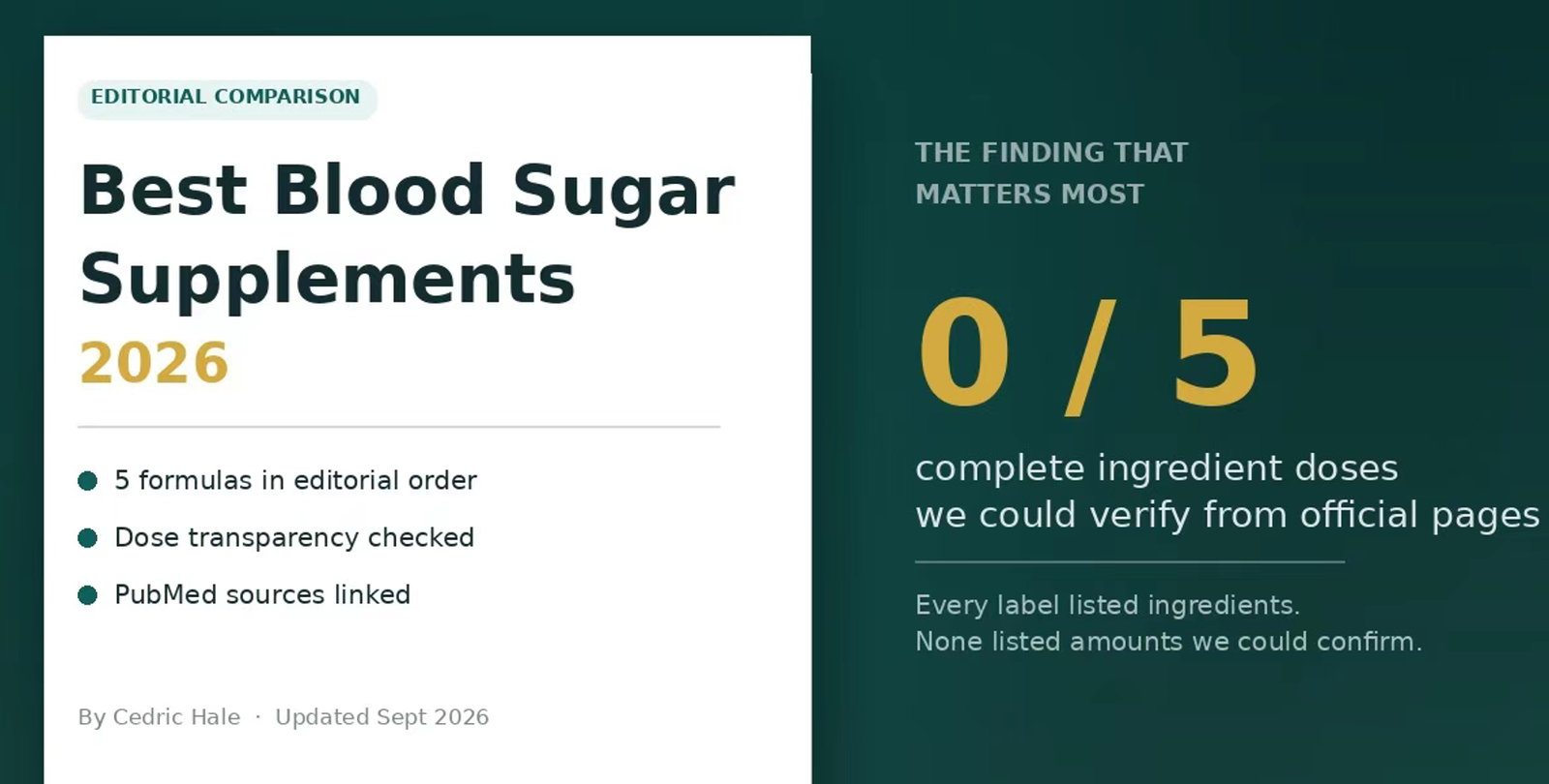
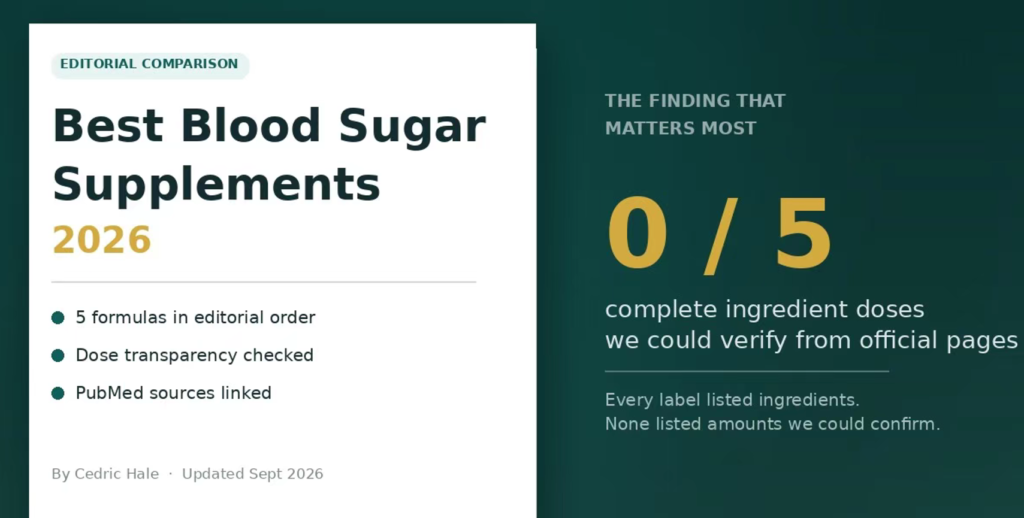
We could not verify a complete dosage panel for any of them. Four of the five published an ingredient list we could read in full; the fifth site was not reachable at all. Every label we were able to read listed its ingredients and stopped there. That single finding shapes this entire guide, and we will come back to it repeatedly.
Our finding up front: LeanBliss and Sugar Defender are the two products whose claims we could trace furthest, for different reasons — and note that we say “trace furthest,” not “best.” This comparison is based on publicly verifiable information, not on clinical testing of the finished products. LeanBliss has the stronger ingredient-level evidence and the longer refund window. Sugar Defender is the more verifiable of the two — it is the only brand here that publishes a reference list — but its list is mixed and its refund window is shorter, which is why it follows in this order. For neither can we verify the doses — and we hope that the dose-transparency problem is the part of this article you remember after the order itself has faded.
Affiliate Disclosure: Some links on this page are affiliate links. If you purchase through them, we may earn a commission at no additional cost to you. The order below reflects the methodology described on this page and is not sold to advertisers.
Table of Contents
Quick Comparison: The Five Products We Compared
| Order | Product | Reported key ingredients | Reported refund window | Doses published? |
|---|---|---|---|---|
| 1 | LeanBliss | Berberine, Ceylon Cinnamon, Saffron, Corosolic Acid, Fucoxanthin | 180 days | No |
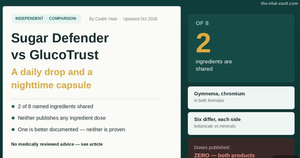
| 2 | Sugar Defender | Gymnema, Chromium, Korean Red Ginseng, Maca, Guarana | 60 days | No |
| 3 | Gluco6 | Ceylon Cinnamon, Chromium, Gymnema | 60 days | No |
| 4 | GlucoTrust | Gymnema, Chromium, Biotin, Manganese, Licorice Root, Cinnamon, Zinc, Juniper | 60 days | No |
| 5 | Amiclear | Gymnema Sylvestre, Ginseng, African Mango, Maca Root, Grape Seed, Astragalus, Coleus, Guarana | 60 days | No |
Why these two sit at the bottom: both publish readable ingredient lists, and neither publishes a single dose. That alone would leave them close together. Amiclear sits last because of what its official site says rather than what it omits — we explain those claims in its section below.
How we compared these products: We did not assign an overall numeric score. Instead, we compared each product across four areas — human evidence for its key ingredients, label transparency, whether the brand’s claims can be checked against primary sources, and the stated refund terms. Where we cite research, we link to the PubMed record. We do not accept payment for placement.
How We Compared These Products
Most “best supplement” lists put products in a sequence without ever explaining how that sequence was produced, which leaves a reader unable to tell whether the order reflects evidence, commercial terms, or something else entirely. So here is what we did, and what the order below can and cannot tell you.
We did not assign an overall numeric score. Instead, we compared each product across four areas:
| Area | What we looked for |
|---|---|
| Human evidence | Whether the product’s headline ingredients have been tested in human clinical trials or meta-analyses, and whether the studies measured blood-sugar outcomes |
| Label transparency | Whether the official product page discloses how much of each ingredient is in a serving |
| Claim verification | Whether the brand’s stated claims and cited studies can be checked against primary sources |
| Refund terms | Whether there is a clear money-back window, and what conditions attach to it |
We use an editorial comparison order based on the four factors above. We did not assign an overall numeric score, and we are not publishing percentage weightings, because these factors cannot be reduced to a scientifically meaningful single score. The four areas are not measured on a common scale, and the underlying evidence varies in quality from ingredient to ingredient. So the order you see below is a considered editorial judgement about which products we could verify more of — not a measurement, and not a claim that product one is “better” in any clinical sense.
One consequence you should understand before reading the order: we do not treat missing dose disclosure as an automatic disqualifier. If we did, all five products would be excluded and this comparison would be empty. Instead, dose transparency is one of four factors.
This is the point where our own method deserves scrutiny, so we will state the tension directly. We say above that dose transparency is the most important single issue for a buyer in this category. We also place a product at the top of that order which we could not fully verify on that exact issue. LeanBliss appears there only on the strength of its reported ingredient evidence and its reported refund period. Its lack of current label verification is a major limitation, and it is the reason we describe it as reported rather than verified throughout. What it means is narrower than a headline summary suggests: among five products where none disclosed usable doses, it is the one whose ingredient list gives us the most to examine, and the one with the longest reported money-back window. It does not mean we confirmed what is in the current bottle, and we did not.
We considered excluding it on that basis and decided against it, because excluding every product that withholds doses would leave this guide with nothing to say. We would rather publish the order with the limitation attached than quietly drop the criterion we have just told you matters most. If you weigh dose disclosure more heavily than we have, the honest conclusion is that none of these five clears that bar — and we would not argue with you.
Two things this comparison does not assess, because we cannot: whether any of these products works for you specifically, and what they are actually like to take. We did not run lab tests and we did not take these products for eight weeks. Claims of that kind are difficult to make credibly across five products at once, and we are not going to imply that we did.
What we actually did was read the product pages available to us line by line, record what each brand claims, compare those claims against published human research, and note where the claims outrun the evidence. Where we could not verify something, we say so rather than filling the gap. That applies to one product below — we could not reach LeanBliss’s official site at all — and it is the reason this article reaches firmer conclusions about ingredients than about finished formulas.
1. LeanBliss — Strong Reported Ingredient Evidence, But Current Formula Not Independently Verified
LeanBliss has the strongest reported ingredient-level evidence among the products we reviewed, based on the ingredient list available to us from an earlier review. Its core ingredient — berberine — is one of the more extensively studied natural compounds in metabolic health.
However, we could not independently verify the current official product page or ingredient doses when this article was prepared. The LeanBliss site returned an access-denied response to our review team on every attempt, so the ingredient list below comes from our earlier review of the product, not from a live check of the brand’s current page. This is the single biggest limitation on this comparison, and it applies to the number one position. What we can say with confidence is conditional: if the current formula contains the ingredients listed below at meaningful doses, then those ingredients have a substantial human research base behind them. We cannot confirm that it does, and neither can any reviewer who has not seen a current supplement facts panel.
That conditional evidence base, and a reported 180-day refund window — the longest reported in this group, though we could not verify its current terms — is what places LeanBliss at the top of this editorial order. Understand what that placement rests on: reported ingredient evidence and a reported refund period, not a confirmed current formula. If verified label disclosure matters more to you than reported ingredient research, then on your own criteria this product would sit differently — and we would not argue with that.
A 2022 systematic review and meta-analysis in Frontiers in Pharmacology pooled 37 studies and concluded that berberine produced measurable reductions in fasting glucose and improvements in lipid markers in people with type 2 diabetes (PubMed). A separate 2021 meta-analysis of 46 randomised trials reached a similar conclusion, reporting an average HbA1c reduction of roughly 0.73 percentage points (PubMed).
For a natural compound, those findings provide a relatively substantial human evidence base. Two caveats matter, and they are the reason the evidence behind the ingredient is not the same as evidence for the finished product. First, both meta-analyses examined berberine on its own, generally at doses between 500 mg and 1,500 mg daily — and LeanBliss does not disclose how much berberine its formula contains. Second, berberine has been reported to interact with several prescription medications. If you take any medication, particularly for diabetes, discuss berberine-containing supplements with a qualified healthcare professional before use.
The formula’s second notable ingredient is saffron extract. A 2022 meta-analysis in Phytotherapy Research examined saffron’s effects on anthropometric and cardiometabolic measures in overweight and obese participants and found modest improvements (PubMed). An earlier randomised placebo-controlled study found that a saffron extract reduced snacking and increased satiety in mildly overweight women (PubMed) — which is the mechanism behind the “cravings” claim.
The ingredient list available to us also includes Ceylon cinnamon. Ceylon cinnamon generally contains substantially less coumarin than Cassia cinnamon, the variety sold in most supermarkets, and coumarin has been associated with liver stress at high sustained intakes. Individual tolerances and appropriate amounts vary, and a qualified healthcare professional can advise if you have any liver concerns.
What we could verify: the published research on berberine, saffron, and Ceylon cinnamon, which we link to above. What we could not verify: the current LeanBliss ingredient list, its doses, its pricing, and the terms of its 180-day refund window — all of which should be read as reported rather than confirmed. Our full ingredient-by-ingredient analysis is in our complete LeanBliss review. Check the official page directly before ordering, because none of the specifics here are confirmed against a live source.
See current LeanBliss packages and refund terms →
2. Sugar Defender — Evidence and Formula Review
Sugar Defender is the only product in this group whose marketing page publishes a reference list at all: it cites research. When we pulled the official site, we read that list in full. It does include relevant studies — chromium supplementation and glucose and insulin variables in type 2 diabetes, ginseng therapy in non-insulin-dependent diabetes, and a chromium meta-analysis. It also contains references that have nothing to do with blood sugar (see below).
That mixed list is what keeps Sugar Defender high in this order rather than lower. It is not the strongest formula here, and it is not the most trustworthy citation set either — but it is the only one we could check at all, and two of its ingredients have genuine human data behind them. Because Sugar Defender provides at least some references that can be checked, it gives us more information to examine than products that publish no references at all. That is the whole basis for its position here. It does not overtake LeanBliss, whose reported ingredient evidence is stronger and whose reported refund window is three times as long.
What the reference list actually contains. The page lists roughly twenty references. We checked them by title. Several are directly on-topic. Several are not, and a few have no plausible relationship to a blood sugar product:
- Korean red ginseng and arterial stiffness in hypertension — a cardiovascular measurement, not a glucose outcome.
- Panax ginseng, muscle damage, and inflammation after uphill treadmill running — an exercise-recovery study.
- Eleutherococcus senticosus and endurance capacity — an athletic performance study.
- “Yale scientists study how some insulin-producing cells survive in type 1 diabetes” — this is a news-style headline, not a study on any ingredient in the formula.
We are not claiming these references were chosen in bad faith, and we cannot know why any individual item was included. What we can report is what a reader sees: a reference list that mixes on-topic human trials with unrelated sports-nutrition and news items, presented without distinguishing between them. If you evaluate a supplement by counting citations, this is the failure mode that count produces. The right question is not “how many references” but “does each reference measure the outcome the product claims.”
What the ingredients do (and do not) have going for them
Chromium has the most consistent evidence in this formula. A 2014 systematic review and meta-analysis published in the Journal of Clinical Pharmacy and Therapeutics examined chromium supplementation in diabetes and reported improvements in glycaemic control, though the authors noted the effect sizes were modest and study quality varied (PubMed).
Gymnema sylvestre is backed by one of the older human trials in this category. A 1990 clinical trial published in the Journal of Ethnopharmacology gave Gymnema leaf extract to patients with non-insulin-dependent diabetes and reported reductions in fasting blood glucose (PubMed). That study is more than three decades old and small by modern standards, so treat it as promising rather than settled.
Korean red ginseng is where the brand’s own citations get shakier. One of the studies linked on the Sugar Defender page examines ginseng’s effect on arterial stiffness in people with hypertension — a cardiovascular measurement, not a blood sugar outcome. A separate 2000 randomised trial in the Archives of Internal Medicine did show that American ginseng reduced postprandial glycaemia, but the effect appeared in non-diabetic subjects as well as those with type 2 diabetes (PubMed). Ginseng is not without research behind it, but the blood sugar case for it is weaker than the marketing implies.
Maca and Guarana are the two ingredients in this formula we could not corroborate. We did not find convincing human clinical evidence supporting either for blood glucose control in the sources we reviewed.
Where it loses ground: we could not verify published doses for this formula, which works against it on the transparency criterion. Sugar Defender is one of the products here we could read in full, so for this one it is a confirmed gap rather than an unknown. You can read our full breakdown in our complete Sugar Defender review.
View the official Sugar Defender page, current pricing, and refund terms →
3. Gluco6 — A Simpler Three-Ingredient Formula
Gluco6 keeps its ingredient list short, which is usually a good sign. The official page lists three ingredients: Ceylon cinnamon, chromium, and gymnema.
What makes this one worth a look is the specificity of the cinnamon claim. The product page states plainly: “Not the stuff in your cupboard. Concentrated Ceylon cinnamon that supports healthy insulin response.” That is a specific, checkable distinction rather than vague marketing language — and it is exactly the kind of claim our verification criterion is designed to reward.
Cinnamon has been tested in diabetes more than almost any other culinary ingredient. A Cochrane systematic review published in 2012 examined cinnamon for diabetes mellitus and found that while some trials reported improvements in fasting glucose, the evidence was inconsistent and study quality was generally poor (PubMed). A more focused 2013 meta-analysis in the Annals of Family Medicine found that cinnamon did lower fasting glucose in people with type 2 diabetes, but the effect was small and varied by the type and dose of cinnamon used (PubMed).
The honest summary: cinnamon may have a modest effect, but the evidence is inconsistent. Type appears to matter — several trials that failed used Cassia, while the positive ones more often used Ceylon. Gluco6 at least got that part right.
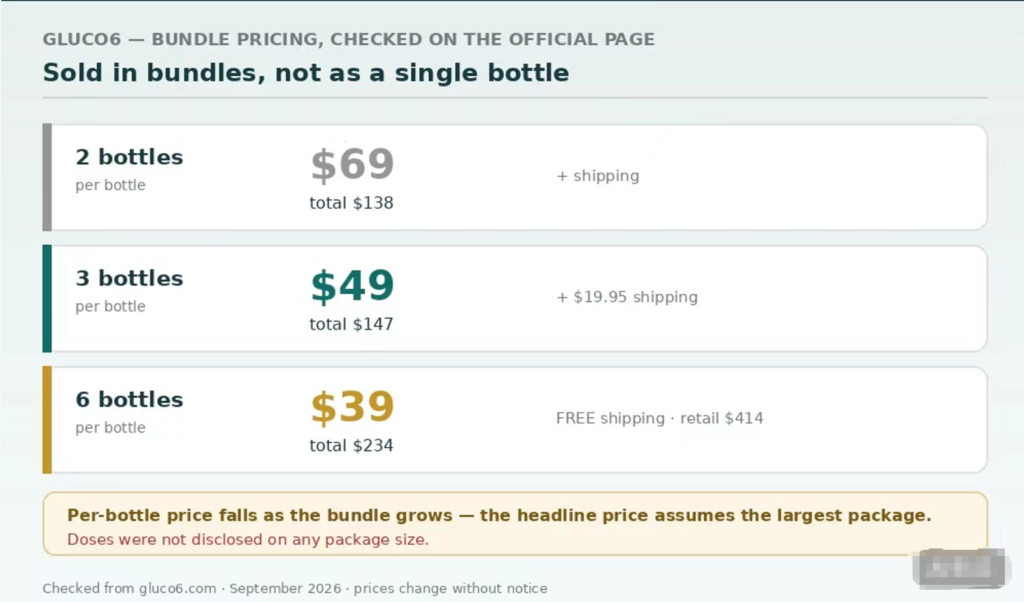
Pricing on the official page at the time of review: Gluco6 is sold in bundles rather than as a single bottle. The two-bottle package was listed at $69 per bottle ($138 total, plus shipping); the three-bottle package at $49 per bottle ($147 total); and the six-bottle package at $39 per bottle ($234 total), against a stated retail value of $414. Per-bottle cost falls as the bundle size rises, which is standard in this category — and worth noting, because the headline per-bottle price usually assumes the largest package.
Read the refund conditions, not just the window. Gluco6’s 60-day money-back promise is real, but the official page states it two different ways in two different places, and the difference matters. The main guarantee section says to “return any unused bottles and cover a minimal shipping cost.” The FAQ further down says “just return the bottles (even if empty)… less shipping and handling fees.” Those are not the same offer: one implies unopened bottles, the other accepts empty ones. We cannot tell you which applies to your order, and that ambiguity is itself worth knowing about before you buy. Either way, shipping is not refunded.

Where it gains and loses ground: a clean, restrained ingredient list with two of three ingredients backed by human data, and a specific verifiable claim about cinnamon type. It loses on transparency in the same way as the products above, and it does less than the two placed above it.
If you want to check the current pricing, refund wording, or ingredient panel yourself, read both versions of the refund terms described above before ordering.
See current Gluco6 packages, pricing, and refund terms →
4. GlucoTrust — A Readable Label That Still Shows No Doses
GlucoTrust is one of the longest-running products in this category, and unlike the product at the top of this order, its official site gave us a full ingredient list to read. That is worth something. What it did not give us is a single dose.
What the official site lists: Gymnema sylvestre, biotin, chromium, manganese, licorice root, cinnamon, zinc, and juniper berries. The page also refers to “a blend of 15 herbs” beyond the named ingredients, without saying what they are or how much of anything is present.
Three of those named ingredients have genuine human research behind them. Gymnema sylvestre has a small human trial in people with diabetes (PubMed). Chromium has a systematic review and meta-analysis on glycaemic control (PubMed). Cinnamon has been reviewed twice, including a Cochrane review (PubMed) and a later meta-analysis in type 2 diabetes (PubMed).
Pricing on the official page at the time of review: one bottle at $69 plus $9.99 shipping; three bottles at $59 per bottle ($177 total, shipping included); six bottles at $49 per bottle ($294 total, shipping included). The page lists much higher “original” totals alongside these, and it states two slightly different figures for the six-bottle original price in two places — we are reporting the current prices, not the claimed discounts.
Refund terms: a 60-day money-back guarantee, described on the page as “no questions asked.” The site states explicitly that you can request a refund even if you never open the bottle. ClickBank is named as the retailer of record, which means refunds are processed through its system rather than by the brand directly — in practice that is usually a smoother route than dealing with a vendor.
Where it gains and loses ground: it gains on being readable — we could check its ingredient list against published research, which we could not do for every product here. It loses on the same transparency point as everything else in this guide: eight named ingredients and a claimed fifteen-herb blend, and not one number on any of them. We found no claims on this page of the kind we flag in the next section, which is part of why it sits above Amiclear.
View the official GlucoTrust page, current pricing, and refund terms →
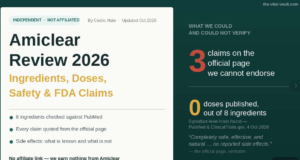
5. Amiclear — Ingredients We Could Verify, Claims We Cannot Endorse
Amiclear is a liquid: each bottle contains 60 ml, and the instructions are to place the drops under the tongue or dissolve them in water, once daily before breakfast. Its official site publishes a full ingredient list. It also publishes statements we think you should see before you buy, and we have reproduced them below rather than paraphrasing them.
What the official site lists: Gymnema sylvestre, ginseng, African mango (Irvingia gabonensis), maca root, grape seed, astragalus, coleus, and guarana. The page also names copper once, in a separate sentence, but copper is not part of the company's own list of eight ingredients — and, like everything else here, it carries no published amount. The site describes the formula as a proprietary blend and, like every other product in this guide, publishes no amount for any ingredient.Two of those have human evidence worth noting. Gymnema sylvestre has a small trial in people with diabetes (PubMed), and American ginseng has been studied for post-meal glucose response in non-diabetic and diabetic participants (PubMed). The rest have far less to support them, and the site says so itself: “While maca root and guarana have few studies confirming their blood sugar effects, African mango extract does have evidence of its blood sugar supporting effects.” A vendor admitting that two of its headline ingredients lack blood-sugar evidence is unusual, and it is to their credit.
Pricing and refunds: the page states a price of $49 per bottle and mentions that three- and six-bottle purchases include two bonus eBooks, but it does not display the multi-bottle pricing on the main page — you reach that at checkout. Refunds are a 60-day, 100% money-back guarantee, stated four times in total. Two of those statements say an empty bottle still qualifies; two others, including the FAQ answer, describe returning what you have not used. We recommend confirming which applies with support before you buy.
Three statements on the official site we would not repeat:
- It calls itself a medication. The page describes Amiclear Drop as “a natural medication that helps to regulate blood glucose levels.” A dietary supplement is not a medication, and a company describing its own supplement as one is telling you something about how it positions the product.
- It suggests you may need less prescribed medication. The page states that “there is less need for you to take large amounts of insulin or other diabetic medications.” We have reproduced it because you should know it is there. If you use insulin or any glucose-lowering medication, do not change your dose on the basis of a supplement’s marketing page — speak to the clinician who prescribed it. Some of the ingredients discussed in this article have been studied for effects on blood glucose, which is precisely why decisions about medication belong to a qualified healthcare professional rather than a sales page.
- The FDA wording is easy to misread. The page carries an “FDA Approved Facility” badge and includes an FAQ asking “Is Amiclear Approved By The FDA?” The FDA states plainly that it “does NOT have the authority to approve dietary supplements for safety and effectiveness, or to approve their labeling, before the supplements are sold to the public” (FDA 101: Dietary Supplements). Registering a manufacturing facility is not the same thing as approving a product. The site’s own footer disclaimer is correct on this point, but it sits several thousand words away from the badge.
One practical warning: several domains now carry the Amiclear name that are not the brand’s site. When we checked, amiclear.com was a parked domain listed for sale and tryamiclear.com had been replaced with an unrelated link directory. The site we reviewed is amiclear.org. If you decide to buy, confirm you are on the domain you intend to be on before entering payment details.
Where it loses ground: not on its ingredient list, which we could read, and not on its refund terms, which are clear. It sits last because of the claims above — specifically the suggestion that it reduces the need for prescribed diabetes medication. In a category where we already found no product willing to publish a dose, a page that also tells readers they may need less insulin is the one we would want you to read most carefully.
We do not have an affiliate link for Amiclear. If you want to check its pricing, ingredient panel, or refund terms yourself, open the official site directly — and read the medication-related statements quoted above before you decide anything.
The Dose Problem: What Missing Ingredient Amounts Mean for Buyers
This is the most important section in this guide, and it is why we built the comparison table around dose disclosure rather than price. It is also the framework we apply to every supplement we review on this site, not just these five.
When we pulled the official product pages for the five products compared in this guide — Sugar Defender, LeanBliss, Gluco6, GlucoTrust, and Amiclear — we searched each one for ingredient quantities: any number followed by “mg” or “mcg”. We could not verify published ingredient amounts on any of the five. All five published an ingredient list we could read. Not one published a dose. We are reporting the absence of published amounts, not a proved fact about what is in the bottles — a brand may disclose amounts on the physical label that its website omits, and we cannot rule that out from here.
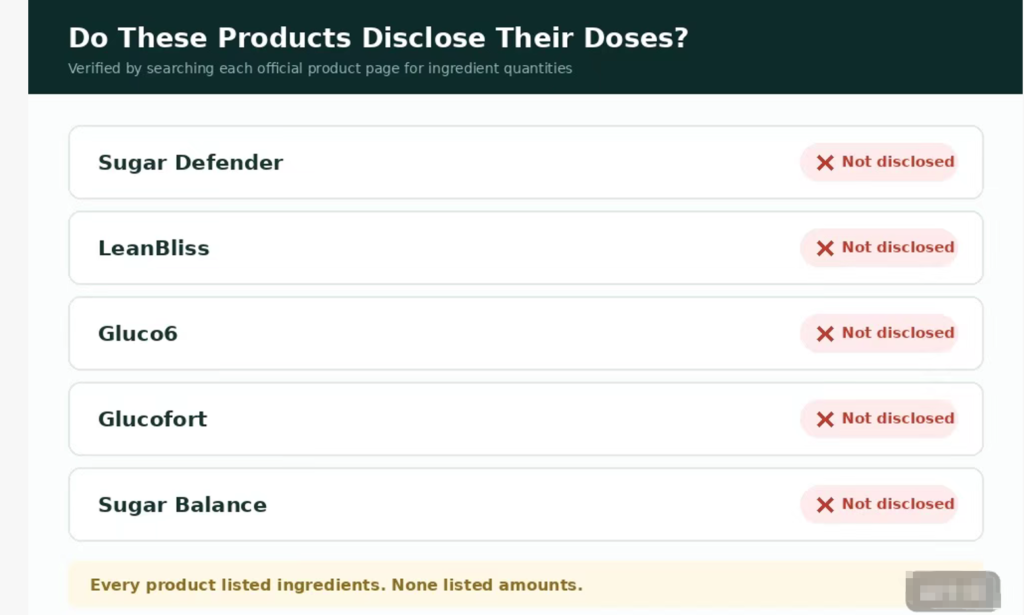

Every product page we could read listed its ingredients without giving a complete ingredient-by-ingredient dosage picture. In some cases this may reflect a proprietary blend, where a manufacturer groups ingredients under a single figure and discloses only the total. In others, the public product page simply does not provide enough information to verify the amounts at all. Those are different situations, and we are not able to tell from the outside which applies to which product.
What we can say is that the effect on you as a buyer is the same. Here is why it matters. The berberine studies behind the LeanBliss claims used doses between roughly 500 mg and 1,500 mg per day. The chromium meta-analysis pooled trials using commonly 200 mcg to 1,000 mcg daily. The Gymnema trial used a standardised extract with a defined gymnemic acid content. None of these products tell you whether their formula contains those amounts, a fraction of them, or more.
A bottle can legally list “Berberine” on its label while delivering a dose far below anything that was ever tested in a clinical setting. The ingredient list tells you what is in the bottle. It does not tell you whether the amount matters.
We cannot determine from the public product pages why these brands do not disclose full ingredient amounts, and we are not going to speculate about their reasons. What we can describe is the effect on you as a buyer: when a label lists an ingredient without an amount, the ingredient list is left to do the work that evidence is supposed to do.
What you can do about it:
- Prefer products that publish doses. In this category they are rare, which is why we highlighted the issue rather than treating it as a footnote.
- Check whether the brand’s cited studies used the ingredient alone. A finished formula with six ingredients has not been tested as a formula, no matter how well each ingredient was studied separately.
- Use the refund window to observe your own response. Blood glucose response varies considerably between individuals, and a stated money-back period is the one mechanism that lets you evaluate a product against your own experience rather than a marketing page. Changes in blood sugar are best assessed with a clinician’s guidance.
Ingredients With Real Human Evidence — And What They Actually Show
Not every ingredient in this category is marketing filler. A handful have been tested in humans with results worth knowing. Here is what the research we reviewed actually supports.
Berberine
Berberine has the deepest human research base among the ingredients we reviewed for this guide. Two separate meta-analyses, covering 37 and 46 randomised trials respectively, found improvements in fasting glucose and HbA1c (Xie 2022; Guo 2021). Doses used in the literature generally start around 500 mg daily. Berberine has been reported to interact with several prescription medications — including some diabetes drugs and certain antibiotics — so professional guidance is important before use.
Chromium
Reasonable evidence, modest effect. A 2014 meta-analysis found improvements in glycaemic control in diabetes, with the authors cautioning that effect sizes were small (PubMed). Chromium picolinate is the most studied form. If you use insulin or glucose-lowering medication, discuss chromium-containing supplements with a qualified healthcare professional first, since the combination may affect blood sugar control.
Gymnema sylvestre
Promising but dated. The foundational human trial dates to 1990 and reported reductions in fasting glucose in patients with non-insulin-dependent diabetes (PubMed). We did not find a large modern trial replicating it, which is why the evidence is best described as promising rather than established.
Cinnamon (Ceylon vs Cassia)
Cochrane’s 2012 review found inconsistent results across trials (PubMed), while a 2013 meta-analysis found a small but real effect on fasting glucose (PubMed). Ceylon generally contains substantially less coumarin than Cassia, which is one reason the distinction can matter when comparing cinnamon-containing supplements. Coumarin has been associated with liver concerns at high intakes over extended periods; if you take cinnamon daily, a qualified healthcare professional can advise on what is appropriate for your situation.
Saffron
Better evidence for appetite and snacking than for glucose. A 2010 randomised placebo-controlled trial found reduced snacking and increased satiety (PubMed), and a 2022 meta-analysis found modest cardiometabolic effects in overweight participants (PubMed).
Korean and American ginseng
Mixed. A 2000 randomised trial in the Archives of Internal Medicine found reduced postprandial glycaemia, but the effect appeared in non-diabetic participants as well (PubMed). One of the studies cited by Sugar Defender’s own page measures arterial stiffness, not blood glucose — a mismatch worth knowing about.
Red Flags to Watch For
We placed five products in order above, and we are going to spend this section telling you what should make you hesitate about all of them. That is not a contradiction — it is what an honest review of this category looks like.
- No supplement facts panel with doses. The single biggest warning sign, and the one nearly every product in this guide fails. If a brand does not disclose its amounts, you cannot determine whether the formula provides doses comparable to those used in clinical research.
- Cited studies that do not measure blood sugar. We found this on Sugar Defender’s page — a ginseng study about arterial stiffness presented among blood sugar citations. Check what each study actually measured.
- “Clinically proven formula” language. No formula in this guide has been tested as a formula. What exists is research on individual ingredients, which is a different thing.
- Countdown timers and “limited stock” banners. These are standard direct-response tactics and appear across this entire category, including on some of the products we placed at the top of this order. They tell you about the marketing, not the product.
- Reviews with no criticism at all. In this niche, a five-star review with nothing negative to say is usually an affiliate page, not an assessment. Including this guide — check whether we named problems with the products we placed highly.
- Claims about replacing medication. No supplement in this category is a substitute for prescribed diabetes treatment. Any page implying otherwise should be closed immediately.
How We Review Supplements at The Vital Vault
The method above is not specific to this article. It is how this site evaluates every supplement we cover, so it is worth stating plainly and separately.
What we do: We read official product pages and label disclosures. We review the available human clinical literature on each headline ingredient and link to the primary PubMed records whenever possible. We compare the doses used in studies against whatever the brand discloses. We check refund terms. We link every study we cite to its PubMed record so you can verify it independently.
What we do not do: We do not run laboratory tests. We do not conduct our own clinical trials. We do not take every product we review and report personal results. We are not physicians, pharmacists, or registered dietitians, and nothing on this site is medical advice, diagnosis, or treatment. We do not accept payment for reviews, for placement, or for the order in which products appear — we earn commissions on sales made through links, which is how the site stays free and independent of sponsored content.
What this means for you: Treat this comparison as a structured starting point for your own research, not as a recommendation to buy. The most valuable part of this article is not the ordering of five products — it is the dose disclosure problem, which applies to the entire category. If you take medication, are pregnant or nursing, or have a diagnosed condition, talk to a qualified healthcare professional before starting any supplement. That applies to every product in this guide.
You can read more about our standards on our About page.
How to Choose the Right Blood Sugar Supplement
If you take one thing from this guide, take the framework rather than the order. Here is the order we would work through as a buyer.
Start with a conversation, not a purchase. If you have diagnosed diabetes, pre-diabetes, or take any prescription medication, talk to your doctor or pharmacist before adding a supplement. Several ingredients common in this category — berberine in particular — have been reported to interact with prescription drugs. This is not a formality; it is the step most likely to actually affect your outcome.
Then check transparency. Find the supplement facts panel. If it lists ingredients without amounts, you are being asked to buy on faith. You may still decide to — but decide knowing that.
Then check the ingredient-by-ingredient evidence. Use the PubMed links in this article. Read the abstracts. You do not need to understand the statistics to notice whether a study was in humans with diabetes, or in mice, or in cells.
Then look at the refund window. Sixty days is standard; 180 days, as LeanBliss reports, gives you more room — though we could not confirm the current terms of that window. Read the conditions, not just the number of days — ideally with professional guidance if you are monitoring blood sugar.
Finally, set your expectations at the right level. Among the ingredients discussed in this comparison, berberine has one of the more substantial human research bases — one meta-analysis of 46 trials reported an average HbA1c reduction of about 0.73 percentage points. That is meaningful but it is not dramatic, and it came from a specific dose that most products will not disclose. If a formula promises to transform your blood sugar in a week, the promise is the product.
Frequently Asked Questions
Do blood sugar supplements actually work?
Some ingredients have measurable effects in human trials — berberine and chromium most consistently. But “the ingredient works” and “this product works” are different claims, and the products rarely disclose the doses needed to connect them. Expect modest effects at best, and treat exercise, diet, and prescribed treatment as the foundation. Individual results vary considerably.
Why do none of these products list their doses?
In some cases a proprietary blend lets a brand list well-studied ingredients without committing to amounts. In others, the public product page simply does not provide enough information to verify what the formula contains. Either way the practical consequence is the same: you cannot tell from the label alone whether you are getting a clinically studied dose or a token amount.
What is the difference between Ceylon and Cassia cinnamon?
Ceylon cinnamon generally contains substantially less coumarin than Cassia. Coumarin has been associated with liver concerns at high intakes over extended periods, which is one reason the distinction can matter for anyone taking cinnamon daily. Suitable amounts and individual considerations can vary, and a qualified healthcare professional can advise on your situation.
Can I take these with my diabetes medication?
Not without asking a qualified healthcare professional first. Berberine has been reported to interact with several prescription drugs, and ingredients that affect blood sugar may alter how glucose-lowering medication behaves. This is exactly the situation where a pharmacist’s five-minute answer is worth more than any article, including this one.
Which of these five has the deepest ingredient evidence behind it?
LeanBliss, on reported ingredient grounds — berberine has the deepest human research base of anything in this comparison, and its other headline ingredients also have human trials. That is why it appears at the top of this editorial order. Note the qualifier: the ingredient list comes from an earlier review, and we could not verify the current formula, so this reflects the evidence behind the reported ingredients rather than a confirmed label. Sugar Defender follows it and is the more verifiable of the two, but has less human evidence behind its formula and a shorter refund window. Remember that for LeanBliss this rests on the ingredient list available to us, not on a verified current label.
Does a 60-day refund policy mean the product works?
No, but it means the risk is mostly on the seller. It also gives you a period in which to observe your own response. Read the terms carefully — some require the empty bottles to be returned, and some do not. Also note that a refund policy says nothing about whether the product is appropriate alongside any medication you take.
Should I buy the largest package to save money?
Only after you know the product agrees with you. The larger bundles carry the deepest discounts, but a three- or six-month supply is a bad first purchase if the formula does not suit you. Start small, use the refund window, then decide.
Bottom Line: The Dose Problem Matters More Than the Order
If you are choosing between these five, LeanBliss and Sugar Defender are the two whose claims we were able to trace furthest — but for different reasons and with different caveats. LeanBliss has the deeper reported ingredient-level research behind it, with berberine supported by two large meta-analyses, and a reported 180-day refund window that no competitor here matches; against that, we could not verify its current label, its doses, or the terms of that window at all. Sugar Defender is the only product here that publishes a reference list, and two of its ingredients have real human trials behind them, but that list mixes on-topic studies with unrelated ones and its refund window is shorter. Gluco6 is the simplest formula of the three we could read.
GlucoTrust and Amiclear appear fourth and fifth, and both publish ingredient lists we were able to read — which is more than we can say for the product at the top of this order. GlucoTrust is the plainer of the two: eight named ingredients, three with human trials behind them, clear pricing, and a 60-day guarantee, and we found no claims on its page of the kind described in the next paragraph. Amiclear appears last for a specific reason that has nothing to do with its ingredient list: its official page states that readers may need less insulin or other diabetes medication. We have quoted that claim above rather than paraphrasing it, so that you can decide what to make of it yourself.
The finding that matters most is not which product comes first. It is that we could not verify complete ingredient doses for any of the five products from their official product pages at the time of review. Every brand in this guide is asking you to trust an ingredient list without disclosing the amounts — or, in two cases, without our being able to confirm whether they do. Berberine’s best evidence comes from 500 to 1,500 mg daily. Chromium’s from a specified mcg range. Gymnema’s from a standardised extract. You cannot tell from any of these labels whether you are getting those amounts.
That does not make the category worthless. It makes it a category where you should read labels closely, set modest expectations, use the refund window as your testing period, and keep a qualified healthcare professional in the loop — particularly if you take medication for diabetes or any other condition. Do that, and a supplement may add something. Skip it, and you are buying a marketing page.
Medical review: This article has not been medically reviewed. It was researched and written using publicly available product information and published scientific literature. The author is not a healthcare professional.
The Vital Vault reviews blood sugar and metabolic supplements using publicly available product information and published human research. We do not provide medical advice, diagnosis, or treatment, and we are not a substitute for consultation with a qualified healthcare professional. Every study cited in this article links directly to its PubMed record so you can read it yourself. We do not accept payment for placement or reviews. Talk to your doctor or pharmacist before starting any supplement, especially if you take prescription medication.
Related Reading
- Sugar Defender Review 2026: Does It Work or Is It a Scam? — our full ingredient-by-ingredient breakdown
- LeanBliss Review 2026: Does This Metabolic Support Supplement Work? — 12 cited studies and a dose transparency analysis
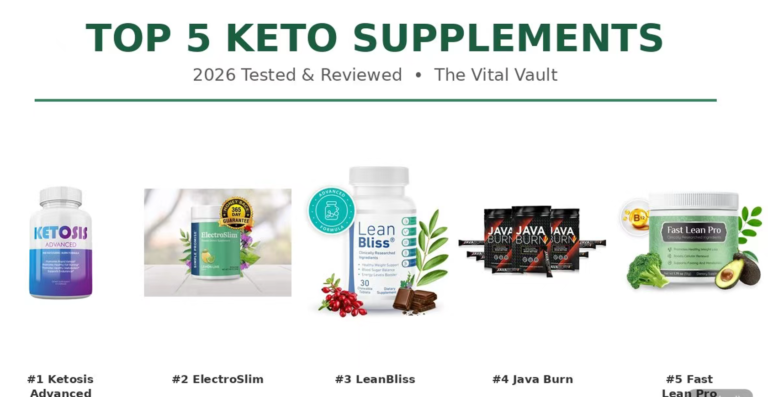
- 5 Best Keto Supplements in 2026 — for readers also working on weight loss
- Ketosis Advanced Review 2026 — BHB ketone supplementation and what the research shows