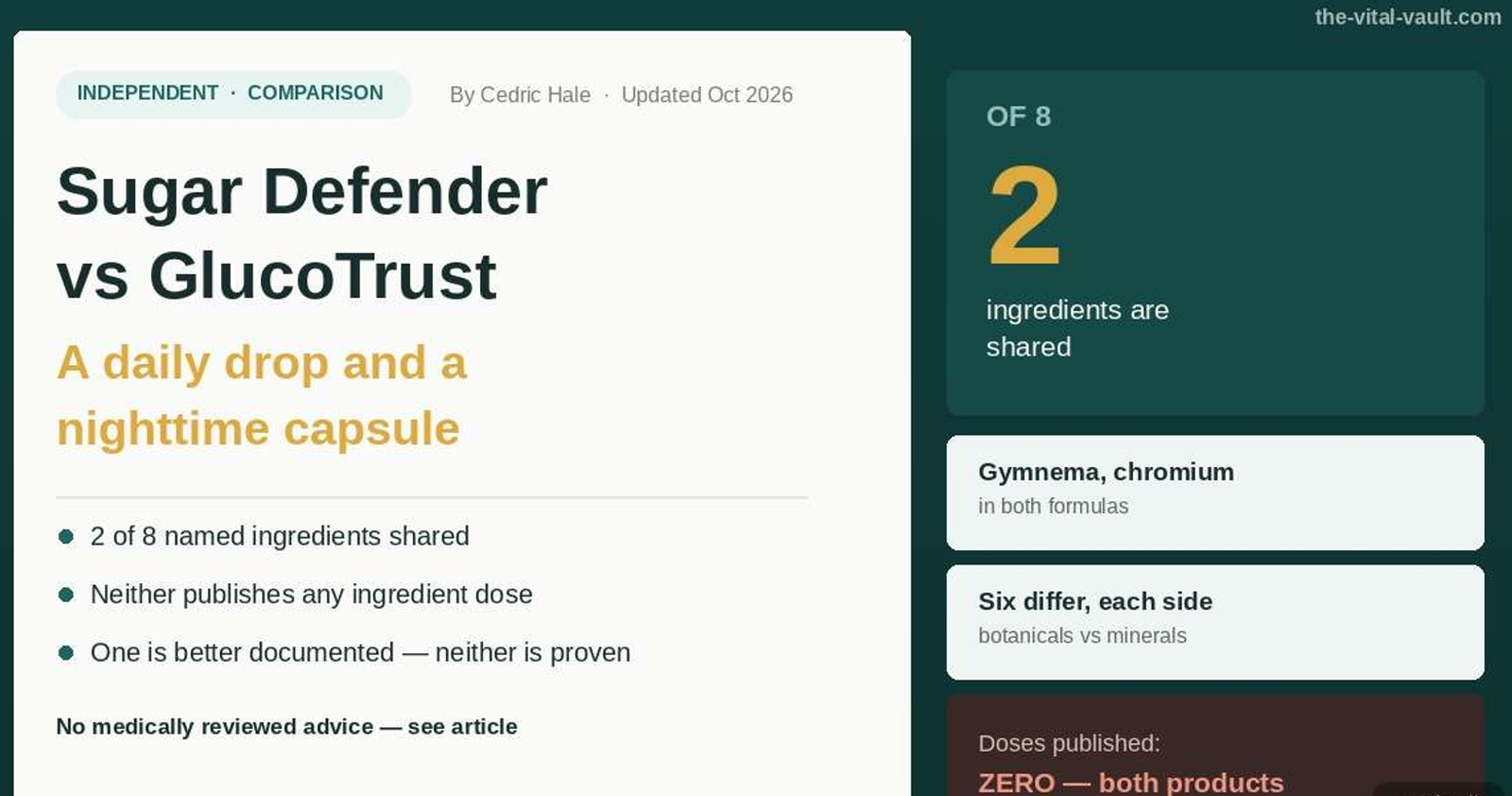
One is a liquid supplement taken daily, with no specific time of day stated on the product pages we reviewed. The other is a capsule taken at night, with its marketing built partly around the promise of better sleep. Sugar Defender and GlucoTrust are sold as competitors in the same category and at the same promotional price. Both products publicly list eight named ingredients. However, GlucoTrust also claims to contain an additional blend of 15 herbs without identifying them, making its full formula less transparent than the headline ingredient count suggests. The two are also making quite different bets about why your blood sugar is a problem.
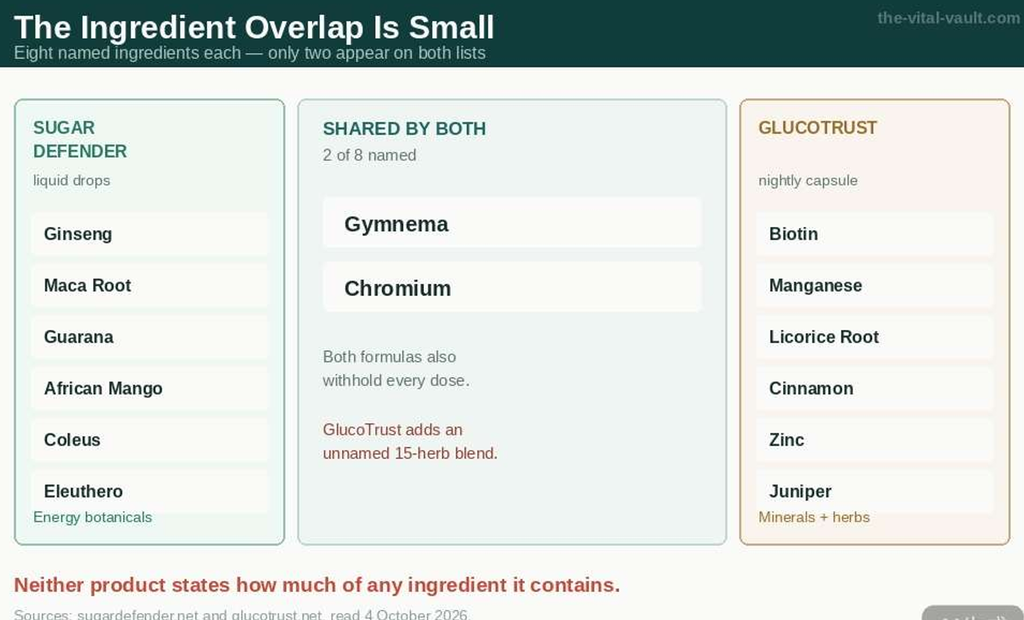
We reviewed Sugar Defender on its own earlier this year. Reading it next to GlucoTrust changes what matters. These two formulas share only two ingredients — Gymnema and chromium — out of eight. That is a much smaller overlap than we expected, and it means this comparison is not a re-run of the same product under two labels. The formulas really are different, and so is the argument each one is making.
What we did not expect to find is that they differ in quality as well as in content. On two measures that have nothing to do with the ingredients — how clearly each states its refund terms, and how carefully each describes the FDA’s role — one of these products is noticeably better than the other. That advantage is confined to commercial and regulatory statements — refunds, retailer, and how the FDA’s role is described. On the formula itself, the same product is the less transparent of the two, because it adds an unnamed 15-herb blend on top of its eight named ingredients.
This article is a comparison, not a re-review of either product. Where we have already examined something in depth, we summarise the finding and link to the full analysis. Everything below comes from the two companies’ own pages as we read them, and from published research we checked against the original abstracts.
Affiliate Disclosure: This article contains affiliate links. If you purchase through these links, The Vital Vault may earn a commission at no additional cost to you. Our comparisons are based on publicly available product information and published research, and affiliate compensation does not determine our conclusions.
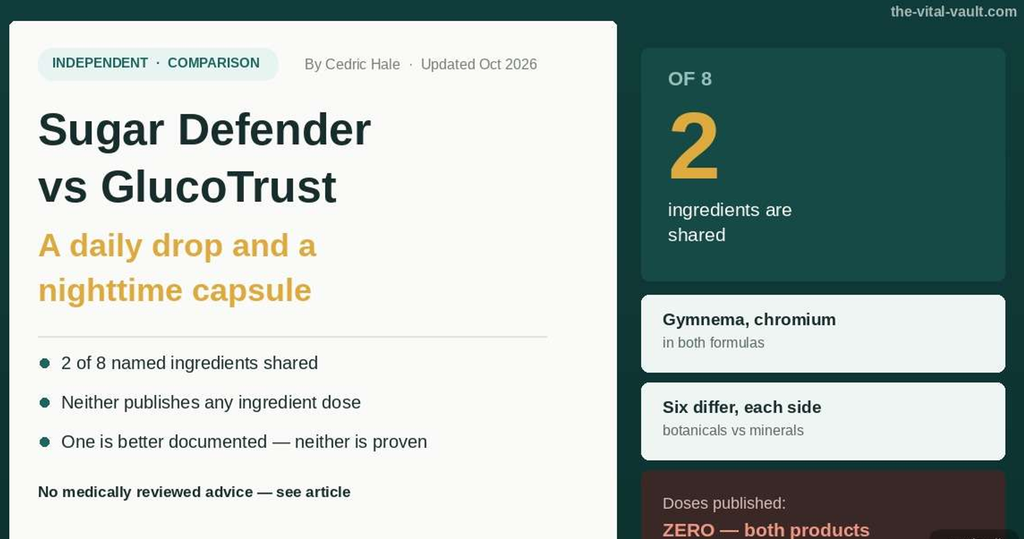
Table of Contents
How We Compared These Two Products
Both products were checked directly from their websites rather than from reseller listings, marketplace pages, or product images. The comparison rests on four kinds of source, and we kept them separate.
Official pages. We read Sugar Defender’s page at sugardefender.net and sugardefender.org, and GlucoTrust’s pages at glucotrust.net and getglucotrust.com, on 4 October 2026. Collapsed sections on each page were opened before reading, because both keep part of their content inside accordion panels that a plain text capture will miss. Where pages disagree with each other, we report the disagreement rather than picking one. Sugar Defender’s domain situation is unusually tangled and we describe it in full below.
Ingredient research. We searched PubMed for each named ingredient combined with glucose-related terms on 4 October 2026 — for example “Gymnema sylvestre” with blood glucose, and “Juniperus communis” with blood glucose. We distinguish throughout between randomised human trials, observational studies, animal work and cell studies, and we say which is which. Where a trial exists but reported no difference between supplement and placebo, we report the null result rather than only the fact that a trial exists. Results were checked against the full scientific name, because a common name in PubMed also returns studies on related but different species.
Other domains. Beyond the four company pages we captured and read in full, we identified a number of further domains presenting themselves as the official Sugar Defender site. These were checked only for basic consistency — ingredient list, headline price and stated refund period — and not captured as dated page archives. Where a claim in this article depends on a specific quotation, it comes from one of the four pages named above. Everything else about those domains is reported as an observation, not as a verified capture.
Product-level research. We searched PubMed for the product names “Sugar Defender” and “GlucoTrust”, and searched ClinicalTrials.gov for both terms, on 4 October 2026. Neither database returned a record for either product. We report this as a search result, not as proof that no product-level study exists: an unregistered or unpublished study would appear in neither.
Regulatory claims. We checked statements about the FDA against the FDA’s own published guidance. This turned out to matter more here than in most comparisons, because the two products use noticeably different language when describing their manufacturing and regulatory status. One makes an explicit claim of FDA certification that the FDA does not issue for dietary supplements. The other uses more restrained wording, but its facility registration and GMP certification claims still require clarification. We examine both against the FDA’s published guidance below.
This was a focused literature review rather than a formal systematic review. We prioritised human clinical trials and systematic reviews, while using animal and laboratory studies only as supporting context. Ingredient evidence was not treated as evidence of finished-product effectiveness. Where a common name returned studies on several species, we restricted ourselves to the studies on the named species. We worked from published abstracts rather than full papers, and we have not assessed study risk of bias independently.
Two limits apply throughout. We worked from websites, not from physical bottles, so a label printed on packaging is not something we can see — and for both products this is the single most important missing piece of information. And we have not been medically reviewed; see the note at the end.
Sugar Defender vs GlucoTrust: Quick Verdict
Here is what we found, in five points.
- Two of the eight publicly named ingredients overlap. Gymnema and chromium. Sugar Defender’s other named ingredients are botanicals aimed at energy and weight; GlucoTrust’s are micronutrients and herbs marketed as supporting insulin function and sleep. We cannot assess any overlap within GlucoTrust’s undisclosed 15-herb blend.
- They are positioned at different points in the day. Sugar Defender is a liquid drop taken daily, with no time of day specified on the pages we read. GlucoTrust is a capsule taken at night, and sleep improvement is one of its three headline promises.
- Neither publishes any ingredient dose. No milligram amounts, no extract standardisation, no blend totals. This is the same failure in both cases and it limits everything else.
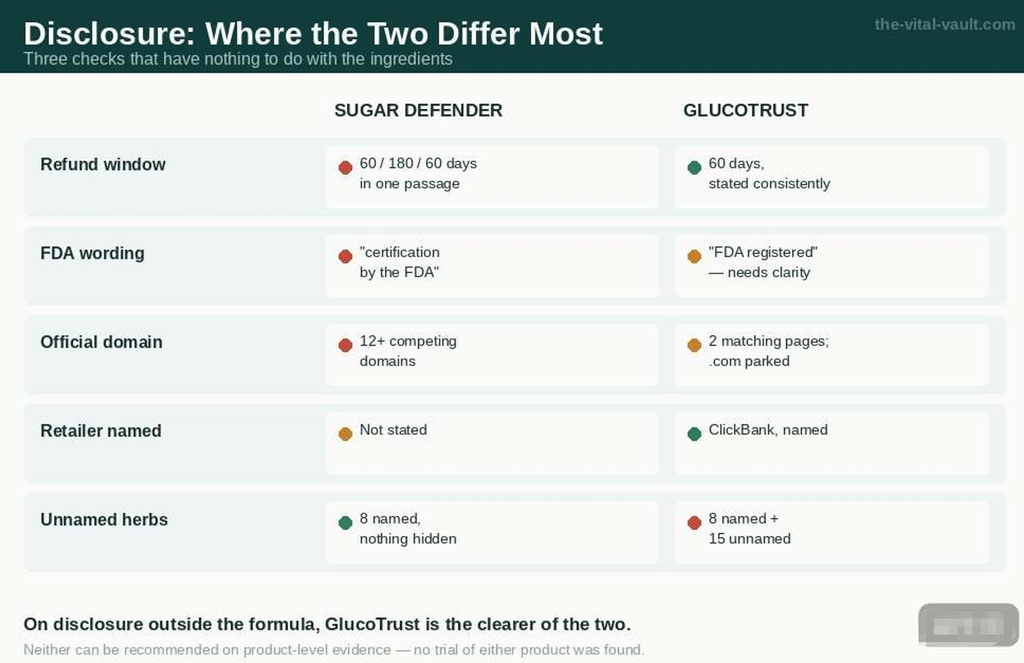
- GlucoTrust is the more transparent of the two on everything except the formula. Its refund terms are consistent and unusually generous, its FDA wording describes a real regulatory process, even if it stops short of full clarification, and its retailer is named. Sugar Defender’s page states three different refund durations in one passage, claims FDA certification that the FDA does not issue, and is spread across at least twelve domains claiming to be official.
- GlucoTrust also has the bigger transparency problem inside the formula. It claims a “blend of 15 herbs” that it does not name, on top of the eight it does.
Side-by-Side Comparison
Every row below is drawn from the pages as we read them on 4 October 2026. Where a page does not state something, the cell says so rather than leaving it blank, because an omission and a zero are different things.
| Feature | Sugar Defender | GlucoTrust |
|---|---|---|
| Format | Liquid drops | Capsule |
| When you take it | Daily; time of day not specified on the pages we read | One capsule each night before bed |
| Headline promise | Blood sugar support, energy, weight | Blood sugar support, deeper sleep, reduced cravings |
| Ingredients named | 8 | 8, plus an unnamed “blend of 15 herbs” |
| Shared ingredients | Two shared among the named ingredients: Gymnema and chromium | |
| Listed only here | Ginseng, maca, guarana, African mango, coleus, eleuthero | Biotin, manganese, licorice root, cinnamon, zinc, juniper |
| Promotional price | $49 per bottle (6 bottles, $294 total) | $49 per bottle (6 bottles, $294 total) |
| Single bottle | $69 on one domain; $49 promotional on another | $69 per bottle |
| Stated “regular” price | $179 per bottle | $197 per bottle |
| Refund window | 60 days in the heading, 180 in the body, 60 in the condition — same passage | 60 days, stated consistently |
| Refund conditions | Not fully stated on the page we read | “No questions asked”; expressly covers unopened product |
| Ingredient doses | None published | None published |
| FDA wording | “Got certification by the FDA” | “FDA registered and GMP certified facility” |
| Safety claim | “100% natural and side effect free.” | “We have not received one complaint about side effects.” |
| Retailer named | Not stated on the pages we read | Stated (“ClickBank is the trusted retailer”) |
| Official domain | Not determinable; at least 12 domains carry the brand | glucotrust.net and getglucotrust.com; glucotrust.com is parked for sale |
| Product-level study | None found in PubMed or ClinicalTrials.gov | None found in PubMed or ClinicalTrials.gov |
Sugar Defender vs GlucoTrust: Key Differences
Most comparisons in this category are comparing the same product twice. This is not one of them, and the clearest sign is what each page promises.
Sugar Defender describes a liquid taken daily that supports blood sugar, energy and weight management. Its ingredient descriptions are about energy, fatigue, cravings and metabolism. The mechanism it is selling is metabolic support during the day.
GlucoTrust describes a capsule taken at night. Its opening line is that the formula “uses natural nutrients that work overnight to support healthy blood sugar levels, improve sleep quality, and reduce unwanted cravings.” Sleep is not an incidental benefit here — it is one of three headline promises, and the dosing instruction reinforces it: “take one capsule each night before bed with a glass of water.”
This is a genuine difference in theory, and it is worth taking seriously, because there is real science behind the sleep-and-glucose connection. We examine that claim in its own section below, because it is the most interesting thing either product is arguing.
It is also the most practical difference for a buyer. If you already take a morning supplement, a nighttime capsule fits around it. If you dislike droppers, or travel with your supplements, a capsule is easier. If you are already sleeping badly, one of these two products is explicitly aimed at that and the other is not. These are not trivial considerations — they are the kind of practical factors that can influence whether someone follows a supplement routine consistently. However, convenience and consistency cannot compensate for an undisclosed formula, missing ingredient doses, or a lack of product-level clinical evidence. A supplement still needs to demonstrate that its formulation is appropriate for the intended purpose.
The Ingredient Overlap Is Smaller Than You Would Expect
Having compared other products in this category that turned out to share six of eight ingredients, we expected the same here. It is not the case.
Shared by both, among the named ingredients: Gymnema and chromium. Two of the eight each product lists publicly.
Only in Sugar Defender: ginseng, maca root, guarana, African mango (Irvingia gabonensis), coleus, eleuthero. Six botanicals, mostly positioned around energy, fatigue and weight.
Only in GlucoTrust: biotin, manganese, licorice root, cinnamon, zinc, juniper. A mix of micronutrients and herbs, positioned around insulin function, hormone balance and sleep.
These are two different formulation philosophies. Sugar Defender’s is a stimulant-and-adaptogen blend — guarana is a caffeine source, eleuthero and maca are sold as energy and fatigue ingredients. GlucoTrust’s is a micronutrient blend — biotin, manganese, zinc and chromium are all nutrients with established roles in metabolism, and the herbs around them are positioned for hormone and sleep support.
Neither approach is obviously wrong. But they are not the same product, and a buyer choosing between them is making a real choice rather than picking between two versions of one formula.
The Two Shared Ingredients: Gymnema and Chromium
These two appear in both formulas, so we treat them separately before looking at what each product adds on its own. As with every ingredient here, neither product states how much it contains.
Gymnema — real but small human data
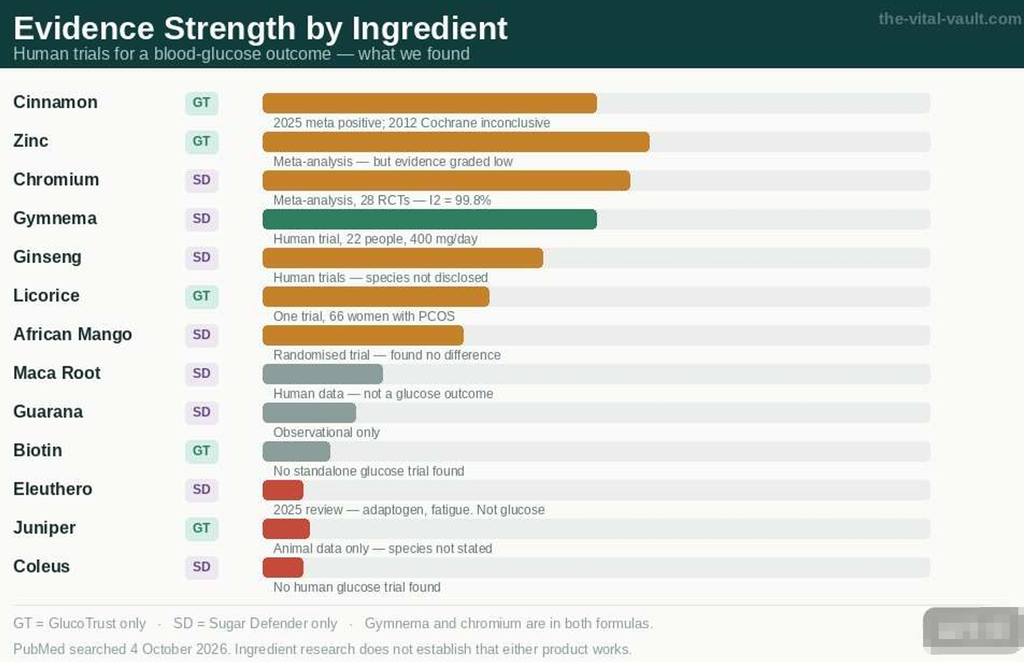
The most relevant human research here is old and small. A trial in 22 people with non-insulin-dependent diabetes tested a specific Gymnema extract at 400 mg/day for 18–20 months alongside their existing oral glucose-lowering medication, and reported reductions in blood glucose and glycated haemoglobin; five of the 22 were able to stop their conventional medication and maintain glucose control on the extract alone (PubMed). That is a real result in humans. It is 22 people, one extract, one dose, in people who already had diabetes and were already medicated. More recent work has examined its effect on sweet-food motivation rather than glucose control (PubMed).
There is a safety signal that applies to both products, since both contain it. A published risk assessment concluded that some Gymnema extracts may enhance the glucose-lowering effect of some antidiabetic drugs (PubMed). A 2022 case report described two patients who developed hepatitis-associated aplastic anaemia after taking ayurvedic and homeopathic remedies with Gymnema named among them; both died (PubMed). Both patients were taking multiple remedies, so this cannot be attributed to Gymnema alone, and two cases cannot establish causation — but severe liver reactions have been reported in connection with products of this kind.
Chromium — pooled trial data, with a large caveat
A 2020 meta-analysis pooled 28 randomised trials in people with type 2 diabetes and found reductions in fasting glucose (weighted mean difference −19.00 mg/dl), HbA1c (−0.71%) and HOMA-IR (−1.53) after chromium supplementation (PubMed).
The caveat is large. Heterogeneity was extreme — I² was 99.8% for fasting glucose — meaning the underlying trials disagreed with each other almost completely. The pooled figure describes a very inconsistent literature more than it estimates a single reliable effect. A 2024 systematic review describes doses in this literature ranging from 50 to 1000 μg/day over two to six months (PubMed). Neither product says where in that range it falls.
Sugar Defender’s Six: What the Evidence Says
We covered most of these in our full Sugar Defender review, so we will summarise rather than repeat, and give the evidence grade for each.
Ginseng, African mango, maca, guarana, coleus and eleuthero
African mango has been tested in a randomised, placebo-controlled trial at 300 mg/day for 12 weeks in overweight and obese adults (PubMed). The extract raised vitamin C and adiponectin, but the study reported no differences between groups in metabolism, inflammation or body composition, and blood sugar was not a primary measure. A 2024 review is explicit that much of the evidence remains preclinical (PubMed).
Ginseng has real research behind it — American ginseng reduced post-meal glucose in controlled work (PubMed), and a separate trial examined a red ginseng extract (PubMed). The problem is the word: “ginseng” covers several species, the trials used specific ones, and the page does not say which is in the bottle.
Maca and guarana have human research, but not on blood sugar. A randomised crossover trial in 29 postmenopausal women tested 3.3 g/day of maca and measured glucose among other markers (PubMed), and is reported for blood pressure and depression outcomes. Guarana’s human data is observational — a study of 637 elderly Amazonian residents comparing habitual guaraná drinkers with non-drinkers (PubMed).
Coleus and eleuthero have the weakest support for the blood-glucose claims made here. We did not find a randomised human trial testing coleus for a blood glucose outcome. A 2025 review of Eleutherococcus root examined its broader pharmacological and adaptogenic potential, particularly fatigue and asthenia, and highlighted the lack of robust clinical evidence and problems with preparation standardisation (PubMed). That review does not establish a glucose-lowering effect in humans. The glucose-related research we identified for eleuthero was preclinical, involving diabetic mice (PubMed).
Overall, Sugar Defender’s six exclusive ingredients offer limited product-relevant evidence for blood glucose control. Ginseng has some human research, although the specific species and extract used in the product are not disclosed. African mango has been studied primarily for weight-related outcomes rather than blood glucose control, while the available human evidence for maca and guarana does not establish them as effective glucose-management ingredients. We found particularly limited relevant clinical evidence for coleus and eleuthero. Chromium, which has a body of pooled human research, is shared by both products rather than exclusive to Sugar Defender, as is Gymnema. Neither product discloses enough information to determine whether either shared ingredient is present at a studied dose.
GlucoTrust’s Six: What the Evidence Says
This is where the comparison gets interesting, because GlucoTrust’s exclusive ingredients have a different evidence profile — and on the whole, a somewhat better one.
Cinnamon — one of the better-studied exclusive ingredients in GlucoTrust
A 2025 systematic review and meta-analysis of randomised trials in people with type 2 diabetes concluded that cinnamon improves glycaemic and lipid profiles and reduces BMI, and noted the effect was clearest in patients receiving cinnamon in capsule form at a dose of ≤2 g/day (PubMed).
This is not a settled literature. An earlier Cochrane review, covering ten randomised trials in 577 people with type 1 and type 2 diabetes, concluded that there was insufficient evidence to support cinnamon for either condition, and found no statistically significant difference in HbA1c, serum insulin or postprandial glucose (PubMed). The more recent review reaches a more positive conclusion; the two are not the same claim, and readers should see both.
Two further details matter. The population was people who already had type 2 diabetes, not the general population either product is marketed to. And the review found the effect at doses up to 2 g/day — and GlucoTrust does not publish a cinnamon dose, so there is no way to know whether the product delivers anything in that range.
There is also a safety question the page does not address. Cinnamon comes in two main types: Ceylon and Cassia. Cassia contains coumarin, which has documented liver toxicity at higher intakes, and it is the cheaper and more common of the two. GlucoTrust’s page says “cinnamon” without specifying which. That is a real omission. The amount of coumarin exposure depends on the cinnamon species and the dose, and GlucoTrust discloses neither. Our point is not that the product poses a coumarin risk — it is that the risk cannot be assessed from what the company publishes.
Zinc — meta-analysis support, but the underlying trials are weak
We found two high-level summaries. A 2024 umbrella review of interventional meta-analyses concluded that zinc supplementation significantly reduced fasting blood glucose, HOMA-IR, insulin and HbA1c, describing zinc as a potentially effective complementary intervention for type 2 diabetes biomarkers (PubMed). A GRADE-assessed systematic review and dose-response meta-analysis in people with prediabetes and type 2 diabetes reached a similar conclusion — but its authors state that the quality of evidence in the included studies is low or very low for most variables, with high heterogeneity (PubMed).
So zinc has more supporting evidence than most ingredients in this category, and that evidence is still graded low. GlucoTrust’s page describes zinc as something that “can stimulate insulin production in the pancreas,” which is a more specific mechanistic claim than the reviews support.
Licorice root — one trial, in a specific population
A randomised, double-blind, placebo-controlled trial assigned 66 overweight or obese women with polycystic ovary syndrome to 1.5 g/day of licorice extract plus a low-calorie diet, or placebo plus the same diet, for eight weeks (PubMed). The licorice group showed greater improvements in obesity indices, fasting blood sugar, insulin, HOMA-IR and lipid profile. The authors call for further research to confirm the findings.
That is a positive trial, and it is in a narrow population — women with PCOS on a calorie-restricted diet. It is not evidence that licorice root in a nighttime capsule affects blood sugar in the general population.
There is also an important safety consideration. Some licorice preparations contain glycyrrhizin, a compound associated with elevated blood pressure, reduced potassium levels and fluid retention, particularly with prolonged or substantial exposure, and in some cases with heart rhythm problems. This matters most for people who already have high blood pressure, kidney or heart conditions, or who take medication affected by potassium levels. The GlucoTrust page does not identify the licorice extract type, its glycyrrhizin content, or the ingredient dose. That makes it difficult for consumers to assess this risk from the published formula alone.
Biotin, manganese and juniper — where the marketing runs ahead
Biotin. We did not find human trials establishing biotin as a blood-glucose intervention. The research that exists combines it with other compounds — one study examined biotin together with chromium histidinate (PubMed) — so biotin’s individual contribution cannot be separated from it.
Manganese. GlucoTrust’s page states that manganese “stimulates insulin production.” We did not find modern human trials supporting manganese supplementation for glucose control. What we found was older nutritional literature and reviews of micronutrient status in diabetes rather than intervention trials.
Juniper. This is the clearest case of marketing outrunning evidence. GlucoTrust’s page introduces juniper berries with the claim that “Juniper berries were buried in the tombs of ancient pharaohs and used to help the performance of athletes in the Roman Olympics.” The scientific literature on juniper and blood sugar is animal and laboratory work — a 1994 study reported hypoglycaemic activity of juniper berries in animal models (PubMed), and subsequent work has examined extracts and isolated compounds (PubMed). We did not find a human trial. An appeal to ancient Egypt is not evidence, and it is worth saying so plainly because it is the kind of line that reads as reassuring without carrying information.
An additional limitation is that the GlucoTrust page does not identify the botanical species of juniper used in its formula. The published animal studies cited above examined specific species, including Juniperus communis and Juniperus oxycedrus. Without knowing which species is actually present in the product, those findings cannot be directly linked to its formulation.
Net: of GlucoTrust’s six exclusive ingredients, two have meta-analysis support with real qualifications (cinnamon and zinc), one has a positive trial in a specific population (licorice), and three have effectively nothing relevant to blood glucose (biotin, manganese and juniper). That is a somewhat stronger set of ingredient-level references than Sugar Defender’s six — but the margin is thin, both products carry several ingredients with no human evidence for the outcome they are sold for, and none of this establishes that either finished product works.
The Sleep Claim: GlucoTrust’s Boldest Bet
This deserves its own section, because it is the single most distinctive thing either product claims, and because there is real science nearby that is easy to mistake for support.
What the page says. GlucoTrust states that its nutrients “work overnight to support healthy blood sugar levels, improve sleep quality, and reduce unwanted cravings,” and instructs you to take one capsule before bed because “the formula contains calming, sleep-enhancing ingredients that support the body’s healing process and metabolism during deep sleep.”
What the science says about sleep and glucose. There is a genuine, well-documented relationship. A randomised crossover trial in 38 women without cardiometabolic disease curtailed sleep to 6.2 hours per night for six weeks and measured the effect: fasting insulin rose (β = 6.8 pmol/L, P = 0.016) and HOMA-IR rose (β = 0.30, P = 0.016), and the effect was independent of changes in body fat (PubMed). The authors conclude that insufficient sleep is a modifiable risk factor for insulin resistance.
This provides human evidence that insufficient sleep can adversely affect insulin sensitivity, although the study does not establish that a sleep supplement can reverse those effects. It is the most relevant piece of published research behind GlucoTrust’s positioning.
What it does not say. The trial tested what happens when you take sleep away. It did not test whether improving sleep with a supplement lowers blood glucose. Those are two different claims, and the second does not follow automatically from the first.
The chain GlucoTrust is asking you to accept runs: this capsule improves your sleep → better sleep improves your insulin sensitivity → your blood sugar improves. The second link is supported by evidence. The first is not — the page does not name a sleep-supporting ingredient in its list of eight, does not publish a dose for one, and we did not find a trial of GlucoTrust on any sleep outcome. The third link is the product claim itself, and neither product has been tested as a product.
To be fair, GlucoTrust does not explicitly claim to treat insomnia or replace established sleep treatments. However, its language still implies that the formula contains ingredients capable of improving sleep and supporting glucose metabolism overnight. The company does not provide ingredient doses or product-level clinical evidence demonstrating either effect. The distinction matters: a scientifically plausible relationship between sleep and insulin sensitivity does not establish that this particular supplement improves either outcome.
Our reading: the sleep angle is the most interesting idea in this comparison and the one with the most solid science somewhere behind it. It is also, at the moment, an untested inference rather than a demonstrated effect.
Ingredient Dosages: What Both Brands Don’t Disclose
We have written about this at length elsewhere, so we will keep it short, but it applies to both products and it caps everything above.
Neither publishes a single ingredient amount. Not per ingredient, not as a blend total, not as a ratio.
The consequences are identical for both:
- No trial can be matched to either product. The cinnamon meta-analysis found its effect at ≤2 g/day. The Gymnema trial used 400 mg/day. The zinc reviews span a wide dose range. Without published amounts, none of these can be connected to what is in either bottle.
- The two products cannot be compared on their shared ingredients. Both contain Gymnema and chromium. Neither says how much.
- Type-specific risks cannot be checked. This matters most for cinnamon, where Ceylon and Cassia differ on coumarin content, and the page does not say which is used.
GlucoTrust has one additional transparency problem that Sugar Defender does not. Beyond its eight named ingredients, the page states that “each capsule contains a blend of 15 herbs” without naming any of them.
The page describes an additional blend of 15 herbs without identifying them. We cannot determine whether any of those herbs overlap with the eight named ingredients, what botanical species are included, or how much of each is present. That makes the blend impossible to evaluate properly against published research or to check for potential medication interactions, ingredient duplication, allergy concerns, and other ingredient-specific safety issues. For consumers and healthcare professionals, this is a substantial disclosure gap — and a bigger one than a missing milligram number, because a missing number can at least be requested, while an unnamed blend cannot be checked against anything at all.
Price and Refund Terms Compared
On price the two are close to identical.
Sugar Defender lists $49 per bottle when bought in six-bottle quantities ($294 total, free shipping) against a stated regular price of $179; a single bottle is listed at $69 on one of the domains. GlucoTrust lists $69 for one bottle, $59 each for three, and $49 each for six ($294 total), against a stated regular price of $197, with free shipping on multi-bottle orders.
Both end at the same place: about $49 a bottle if you buy six, roughly $180–$200 stated “regular” prices, and the same discount architecture. Neither is cheaper in any meaningful way.
On refund terms, they are not comparable — and GlucoTrust is clearly better.
Sugar Defender’s page (sugardefender.net) manages three different durations in one passage. The section is headed “60-Day Money Back Guarantee”; the first sentence says the product “is backed by a 100% money back guarantee for 180 full days from your original purchase”; and the condition that follows refers to “the first 60 days from your purchase.” We captured this page three times on 4 October 2026 and the wording was identical each time, so this is not a loading artefact. A buyer cannot tell from the page whether they have 60 days or 180.
GlucoTrust’s pages state 60 days consistently, and the conditions are both generous and specific: the guarantee is “no questions asked,” meaning “if you decide to request a refund, you don’t need to explain why. It doesn’t even matter if you never get around to trying it.”
That is a materially better offer and a materially clearer one. A refund policy you cannot read is worth less than a shorter policy you can.
The FDA Claim: One Overstates, One Is More Restrained
This is the sharpest difference in the comparison. Note what it does and does not show: one company’s wording is more restrained, not correct in every particular — its facility registration and GMP certification claims still need clarification, as we set out below.
What GlucoTrust’s pages say
Both GlucoTrust pages we read use the same formulation: the product is “manufactured here in the USA in an FDA registered and GMP certified facility,” or “manufactured in an FDA-registered, GMP-certified facility.”
What Sugar Defender’s pages say
sugardefender.net states that “Every bottle of Sugar Defender is approved by the GMP and got certification by the FDA.” The same page carries a standard disclaimer further down saying that “The FDA hasn’t evaluated the statements provided on this page.” Another domain uses a different formulation again.
What the FDA actually does
The FDA does not approve dietary supplements before sale, does not certify them, and does not certify the facilities that make them. What exists is a registration requirement: facilities that manufacture, pack or hold dietary supplements must register with the FDA and follow current good manufacturing practice rules. Registration is a listing, not an endorsement — and the FDA says so in its own consumer guidance (FDA 101: Dietary Supplements). The same boundary is set out from the claims side in the FDA’s labelling guidance (FDA: Label Claims for Dietary Supplements).
So: GlucoTrust’s wording is more restrained, but it still requires clarification. FDA facility registration is a regulatory requirement for applicable facilities; it does not mean that the FDA has approved the product, certified the facility, or independently verified the supplement’s effectiveness. The separate phrase “GMP certified” should also identify the certifying organisation and the scope of certification. Without that information, we cannot independently verify the certification claim. Sugar Defender’s statement is more problematic. “Certification by the FDA” describes something the FDA does not issue for dietary supplements, and the same page contradicts it in its own disclaimer.
We want to be precise about what this does and does not show. It does not show that GlucoTrust is a better product, or that its facility is in better standing. FDA facility registration is a regulatory requirement for covered facilities, not an endorsement of a manufacturer or evidence that a finished product has been independently verified for quality or effectiveness. It should not be confused with FDA approval, FDA certification, or independent GMP certification. What the difference does show is that one company’s wording describes a real regulatory process, while the other asserts a certification the FDA does not issue for dietary supplements. On a page where you are being asked to enter card details, that difference is worth something.
The Safety Claims
Both products make a version of the same assertion, and we are quoting both so you can compare them directly.
Sugar Defender’s page says:
“Sugar Defender is 100% natural and side effect free. The added ingredients are purely sourced from nature’s extract. Sugar Defender ingredients are 100% pure and organic.”
GlucoTrust’s page says:
“GlucoTrust is 100% natural, safe and effective. Thousands of people enjoy taking GlucoTrust every day and we have not received one complaint about side effects.”
The structure is the same in both: 100% natural, therefore safe, therefore no side effects reported. Neither cites a source, and neither describes any system for collecting the reports it says do not exist.
Two things are worth separating. “Natural” is not a safety category — plants contain active compounds, which is why they are in the formula. Gymnema, present in both, carries a published drug-interaction warning and has been named in case reports of severe liver-related reactions, including two fatal cases of hepatitis-associated aplastic anaemia. And “no complaints received” is not the same as “no adverse effects.” A company that does not describe how it collects reports cannot meaningfully say there have been none.
We are not saying either product has caused harm. Nothing we found establishes that. We are saying the sentence is built to sound like a finding when it is an absence of a reporting process.
GlucoTrust’s page does include one sentence the other does not, and it is the more useful one: “Always consult your doctor if you have concerns.”
Official Websites and Domain Transparency
Both brand names are spread across multiple domains. The situations are not equally bad.
GlucoTrust — messy but navigable
glucotrust.com is a parked page listed for sale through a domain marketplace. The pages that match the product are glucotrust.net and getglucotrust.com, and we read both on 4 October 2026. They are consistent with each other on ingredients, pricing and refund terms. getglucotrust.com also names its payment retailer directly — “ClickBank is the trusted retailer for getglucotrust.com” — which gives a buyer an identifiable checkout and an independent refund route.
Sugar Defender — not determinable
We found at least twelve domains presenting themselves as the official site. We read some of them in full and checked the others only for basic consistency of ingredient list, price and refund terms; the spellings make the scale of the problem visible: sugardefender.net, sugardefender.org, sugardefender.com, sugardefender.io, sugardefender24.com, sugaardefender.com, sugardefensder.com, sugardefeneder.com, sugardefenrder.com, sugrdefenderr.com, us-sugarrdefender.com and sugardefendor.org.
We could not determine which, if any, is operated by the company that makes the product. There is no company name, address or cross-reference that settles it. What we can report is that they disagree with each other: they quote different single-bottle prices, different refund windows, and different FDA wording — and one of them (sugardefensder.com) lists an entirely different formula built around berberine and Corydalis, plus a misspelled “FDA APPROVED FACILTY” badge. At least one appears consistent with an affiliate-operated promotional page, although we could not independently verify who operates it, and it links to unrelated supplement brands.
None of this proves any particular site is fake. It proves that a buyer cannot tell from the domains which one is real.
Which Is Better: Sugar Defender or GlucoTrust?
On the evidence and disclosures set out above, the two products do separate — but not in the way a product page would want them to.
Among the named ingredients, GlucoTrust has a somewhat stronger set of ingredient-level research references. Cinnamon and zinc have meta-analysis support, with the qualifications we set out, and licorice has one positive trial in a specific population. Sugar Defender’s exclusives lean mostly on energy botanicals with little or no glucose evidence, ginseng being the partial exception — it has controlled human research, but the species and extract used are not disclosed. However, this is not evidence that the finished product is more effective, particularly because GlucoTrust’s ingredient doses and additional herbal blend remain undisclosed — as do Sugar Defender’s doses.
On commercial terms — everything outside the bottle — GlucoTrust is clearly ahead. Its refund terms are stated consistently and generously. Its FDA wording describes a real regulatory process, even if it needs clarification. Its retailer is named, which gives you an identifiable checkout and an independent refund route. Sugar Defender’s page states three different refund durations in one passage, claims a certification the FDA does not issue, and is spread across the domains we looked at, which disagree with each other.
On the formula itself, Sugar Defender is ahead on one point. GlucoTrust claims a blend of fifteen herbs it does not name. Sugar Defender names eight and stops there.
On practical fit, they suit different people. If you want a nighttime capsule and you are interested in the sleep angle — which has real science behind the underlying mechanism, even if the product itself is untested — GlucoTrust is the only one of the two making that argument. If you prefer a liquid and want the more conventional botanical approach, Sugar Defender is that. If you are sensitive to stimulants, note that Sugar Defender contains guarana, a caffeine source, and take it accordingly.
Our overall reading: GlucoTrust is the better-documented option of the two based on the information publicly available to us. Its stated refund terms are clearer, its FDA wording is more restrained, and its named retailer provides a more identifiable purchasing route. However, these advantages do not establish that GlucoTrust is more effective, safer, or better formulated. Its undisclosed 15-herb blend and missing ingredient doses remain substantial limitations. We would not describe either product as a well-verified purchase.
But we would put a condition on that. Fifteen unnamed herbs is a real disclosure gap, and the juniper marketing is a real overreach. If you are going to spend money in this category, the most useful comparison is against products that publish their doses — and we have set that out in our roundup of five blood sugar supplements compared on evidence, doses and transparency.
If you take either product alongside prescribed glucose-lowering medication, talk to your prescriber first. This is not boilerplate: Gymnema, which is in both formulas, carries a published warning about enhancing the glucose-lowering effect of antidiabetic drugs, and that is the clearest documented safety issue in this comparison.
People with diabetes, high blood pressure, or kidney or liver conditions, and anyone taking prescription medication, should be particularly cautious about adding multi-ingredient supplements of this kind. GlucoTrust contains licorice, Sugar Defender contains guarana as a caffeine source, and both contain Gymnema. The absence of published ingredient doses makes it harder to evaluate individual risks. A healthcare professional should review the complete ingredient list before use. This is not a statement that these groups cannot use either product — it is a recognition that the risk assessment here needs to be individual.
A quick decision table
Rather than telling you which to buy, here is what the evidence and the disclosures actually support.
| Question | Answer |
|---|---|
| Which is more transparent on commercial terms — refunds, retailer, regulatory wording? | GlucoTrust |
| Which is more transparent about the formula itself? | Sugar Defender — it names eight and stops there; GlucoTrust adds an unnamed 15-herb blend |
| Which has more ingredient-level research behind its exclusives? | GlucoTrust, with limitations |
| Which publishes full ingredient doses? | Neither |
| Which has product-level clinical trials? | Neither — we found none for either |
| Which can be confidently recommended? | Neither — both lack the information needed |
The following are affiliate links, and we may earn a commission if you make a purchase. If you have weighed the above and want to try one: Check current GlucoTrust pricing, packages and refund terms · Check current Sugar Defender pricing and availability.
Before purchasing, verify the retailer shown on the actual checkout page and read the applicable refund terms. Because we could not determine which Sugar Defender domain is the official one, we cannot confirm in advance which checkout page that link will land on — check the seller name, the ingredient list and the refund terms shown on the page before paying. These links route through ClickBank tracking links, and ClickBank provides a customer refund-request process — but its policies do not mean that every request is automatically approved, or that the seller’s stated guarantee can be ignored.
What This Article Does Not Claim
We want the limits of this comparison to be as clear as its findings.
We are not saying either product is fake. Both publish an ingredient list we could read, and nothing here establishes that either fails to contain what its page says.
Three things are easy to confuse, and we keep them separate throughout. Better documented means a company publishes more complete and more internally consistent information about what it sells. Here that advantage sits on commercial and regulatory disclosures only — on the formula itself, GlucoTrust is the less documented of the two, because of the unnamed blend. Stronger ingredient-level evidence means more published research exists on the individual ingredients it contains. Proven product effectiveness means the finished product itself has been shown, in trials of that product, to produce the outcome it is sold for. GlucoTrust is ahead of Sugar Defender on the first two. Neither product has the third — and no amount of the first two can substitute for it.
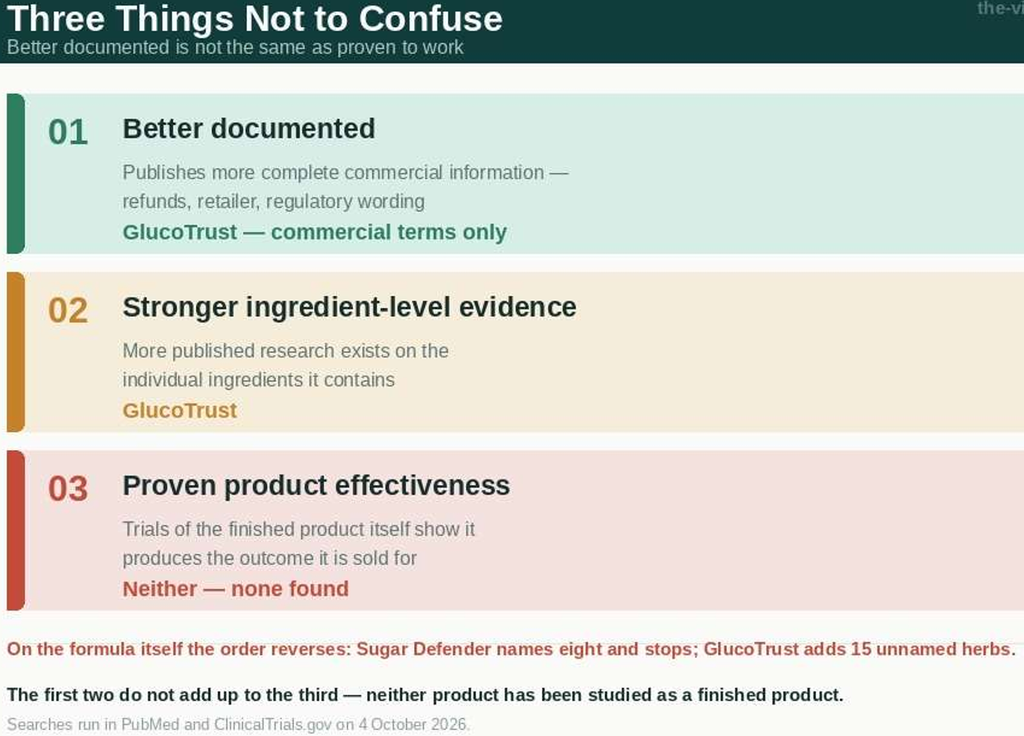
We are not saying GlucoTrust works better. Neither product has been studied as a product. We found no record of either in PubMed or ClinicalTrials.gov. Where we describe GlucoTrust as the better-documented option, that judgement rests on published ingredient evidence and on disclosure quality — not on outcomes, and not on product effectiveness.
We are not saying the sleep mechanism is proven. The evidence supports the link between insufficient sleep and insulin resistance. It does not establish that a supplement that improves sleep lowers blood glucose, and no trial of GlucoTrust on sleep was found.
We are not saying we found no studies because none exist. Where our searches returned nothing — coleus for glucose, or juniper in humans — we report that as a search result. An unindexed or unpublished study would not appear in PubMed.
We have not tested either product. We have not bought a bottle, sent one to a laboratory, or taken either. Everything here comes from the companies’ own pages and from published research.
We are not giving medical advice. See the note below.
Bottom Line
Sugar Defender and GlucoTrust are sold at the same promotional price, and on price and positioning alone they look interchangeable. They are not. Two of their eight publicly named ingredients overlap, one is a daily liquid supplement while the other is specifically intended for nighttime use, and one of them is built around an argument — sleep as a route to better glucose control — that the other does not make.
On the ingredients, GlucoTrust has the slightly better-evidenced set, led by cinnamon and zinc, though both carry real qualifications and neither product publishes a dose. On disclosure, GlucoTrust is clearly better: consistent refund terms stated generously, FDA wording that describes a real regulatory process, and a named retailer. Sugar Defender’s page states three different refund durations in one passage, claims an FDA certification the FDA does not issue, and is spread across at least twelve domains that we observed disagreeing on price, refunds and ingredients.
GlucoTrust’s own weak points are real: fifteen unnamed herbs, and juniper marketed with ancient Egypt rather than human data.
Our conclusion is that GlucoTrust is better documented than Sugar Defender, but neither product provides enough formula transparency or product-level clinical evidence for us to recommend it confidently.
What Consumers Should Look for Before Buying a Blood Sugar Supplement
Before choosing any blood sugar supplement, it is worth looking beyond ingredient names and promotional claims. A more transparent product should provide:
- The exact amount of each active ingredient per serving — not just a list of names.
- The botanical species and extract standardisation where applicable, since the research usually applies to a specific one.
- Clear information about additional ingredients and proprietary blends — an unnamed blend cannot be checked against anything.
- Independent quality testing or verifiable manufacturing certifications, with the certifying organisation named.
- Safety information, including potential medication interactions.
- A clearly stated refund policy and an identifiable retailer.
A supplement containing an ingredient studied in clinical trials is not necessarily equivalent to the supplement used in those trials. The dose, the extract, the formulation and the study population all matter — and when none of those are published, the research cannot be connected to the product at all.
In our comparison, neither Sugar Defender nor GlucoTrust provides enough publicly available information to establish that its formula matches the doses used in relevant human research. For consumers, that is perhaps the most important finding here.
About the Author and How This Was Reviewed
This comparison was written by Cedric Hale, who reviews supplements for The Vital Vault, and is based on direct review of both companies’ own pages, captured on 4 October 2026, together with literature searches run the same day. Every quotation from either company is reproduced verbatim from those captures. Every research claim is linked to the study it came from, and we state the study type — randomised trial, observational study, animal work or cell work — in each case. Cedric Hale is not a medical doctor, registered dietitian, or licensed clinician, and nothing here should be read as clinical advice. Neither company paid us to write this review. We earn a commission only if you buy through one of the links on this page, and that commission does not depend on what we conclude. The page captures, search dates and study identifiers recorded above are the full basis for every factual claim in this article; nothing here is drawn from hands-on product testing, laboratory analysis, or material supplied by either company.
Where a company’s pages contradict themselves, we have reported both versions rather than choosing one. Where our searches came up empty, we have said so instead of treating an empty result as a negative finding.
This article has not been medically reviewed. It is not a substitute for professional medical advice, diagnosis or treatment, and nothing in it should be read as a recommendation to start, stop or change any prescribed medication. Talk to your doctor before adding any supplement, particularly if you take glucose-lowering medication, are pregnant or breastfeeding, or have a diagnosed medical condition. See our full medical disclaimer.
Disclosure: We may earn a commission if you purchase either product through a link on this page. That does not affect our assessment or the price you pay. Where we give GlucoTrust the edge above, it is on published evidence and disclosure quality, not on commission — and it is not a claim that it works better. Both products’ ingredient lists, prices and guarantees are drawn from their own websites and may change without notice — the versions quoted are those we read on 4 October 2026.
Sources
Company pages reviewed and captured in full — sugardefender.net and sugardefender.org; glucotrust.net and getglucotrust.com. All read 4 October 2026. A number of further domains presenting themselves as the official Sugar Defender site were checked only for basic consistency of ingredient list, price and refund terms, and were not captured as dated archives.
Shared ingredients (PubMed)
- Gymnema sylvestre, 400 mg/day, 18–20 months, 22 participants — PMID 2259217
- Gymnema and sweet-food motivation — PMID 39855349
- Gymnema risk assessment, drug-interaction warning — PMID 32626054
- Gymnema, hepatitis-associated aplastic anaemia, two fatal cases — PMID 35318201
- Chromium, meta-analysis of 28 randomised trials — PMID 32730903
- Chromium, systematic review 2000–2024 — PMID 39541030
Sugar Defender exclusives (PubMed)
- African mango, 300 mg, 12 weeks, randomised placebo-controlled — PMID 36364907
- African mango, 2024 review — PMID 38395180
- American ginseng and post-meal glucose — PMID 10761967
- Red ginseng extract, randomised trial — PMID 39969290
- Maca, 3.3 g/day, randomised crossover, 29 participants — PMID 24931003
- Guaraná, observational study, 637 participants — PMID 21341338
- Eleutherococcus root, 2025 review — PMID 41235111
- Eleutheroside E in db/db mice — PMID 23690865
GlucoTrust exclusives (PubMed)
- Cinnamon, systematic review and meta-analysis, type 2 diabetes — PMID 38917435
- Zinc, umbrella review of interventional meta-analyses — PMID 38849958
- Zinc, GRADE-assessed systematic review and dose-response meta-analysis — PMID 37870684
- Licorice extract, randomised trial, 66 women with PCOS — PMID 39080737
- Biotin with chromium histidinate — PMID 30219082
- Juniper berries, hypoglycaemic activity, animal study — PMID 8073081
- Juniper, hypoglycaemic compounds — PMID 22063725
The sleep claim (PubMed)
- Chronic insufficient sleep and insulin sensitivity, randomised trial, 38 women — PMID 37955852
Regulatory guidance — FDA 101: Dietary Supplements; FDA: Label Claims for Dietary Supplements.
Product-level searches — PubMed for “Sugar Defender”: 0 records; PubMed for “GlucoTrust”: 0 records; ClinicalTrials.gov for “Sugar Defender”: 0 studies; ClinicalTrials.gov for “GlucoTrust”: 0 studies. All searches run 4 October 2026.