Quick Verdict
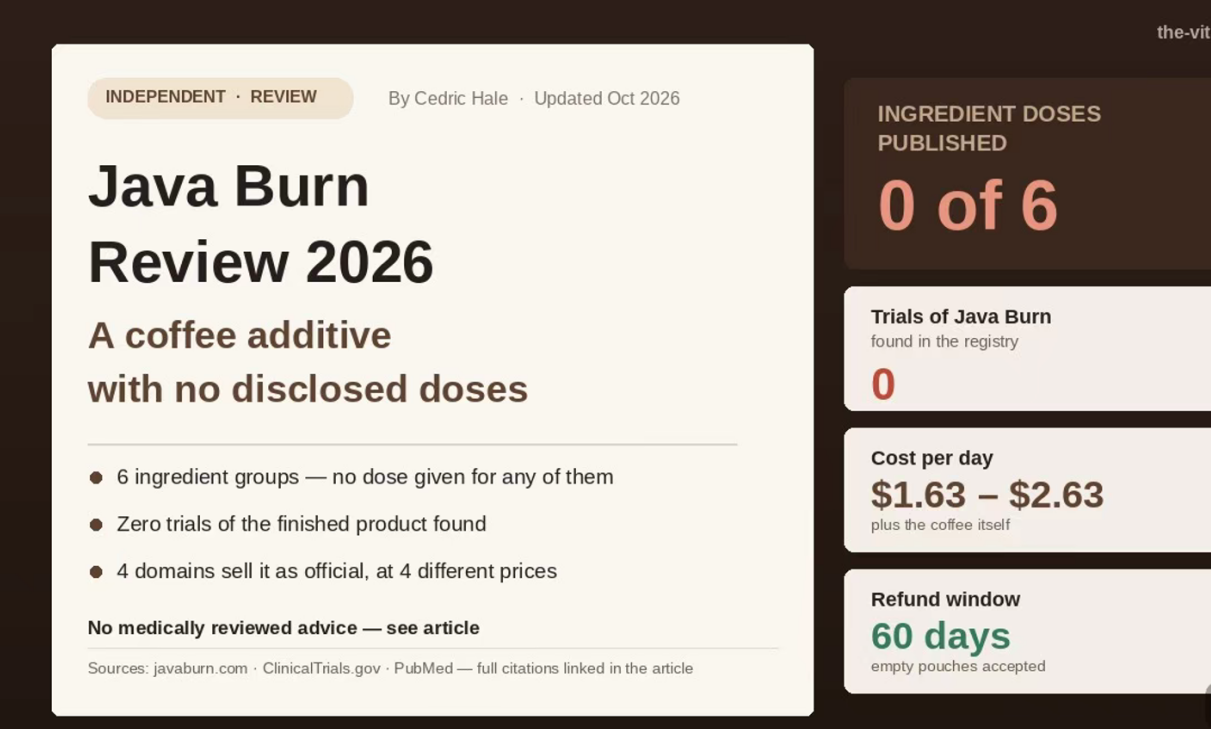
Java Burn review 2026: Java Burn is a single-serve powder you stir into coffee, sold as a way to make your morning cup burn more fat. The most basic question is whether the product itself is supported by any trial. We could not find one, on ClinicalTrials.gov or in PubMed. Not one of its six ingredient groups has a published dose. Four different domains sell it as “official” at four different prices. The sales page advertises a 60-day money-back guarantee, and describes it three different ways: the FAQ says empty pouches are accepted, the terms page says items must be returned undamaged, and the sales letter says there is “simply no risk to you.” All three deduct shipping and handling. We verified the published wording, not whether refunds are consistently honoured in practice. The same page also claims the formula is “scientifically proven” when no trial of it exists.
Ingredient-level research exists, and some of it is positive. But without doses, none of it can be connected to this product. That gap is the whole story.
Table of Contents
What Is Java Burn?
Java Burn is not coffee and not a coffee substitute. It is an additive: a powder in single-serve packets, one packet a day, stirred into brewed coffee. The pitch rests on one idea — that coffee is a “perfect primer” for fat burning, and that adding the right nutrients to it produces a result neither the coffee nor the nutrients would produce alone.
The sales page describes it as the “first and only” product of its kind, “100% safe,” “scientifically proven,” and “unparalleled.” That is a lot of load-bearing language in one sentence, and we take the strongest of those claims — “scientifically proven” — first, because it is the most directly answerable. It is not supported. We searched ClinicalTrials.gov using its v2 API for the exact phrase “Java Burn” and got zero results. We searched PubMed for the product name and found no trial of it either.
What the pages do publish: six named ingredient groups, one packet per day, and no packet weight.
The Six Ingredients
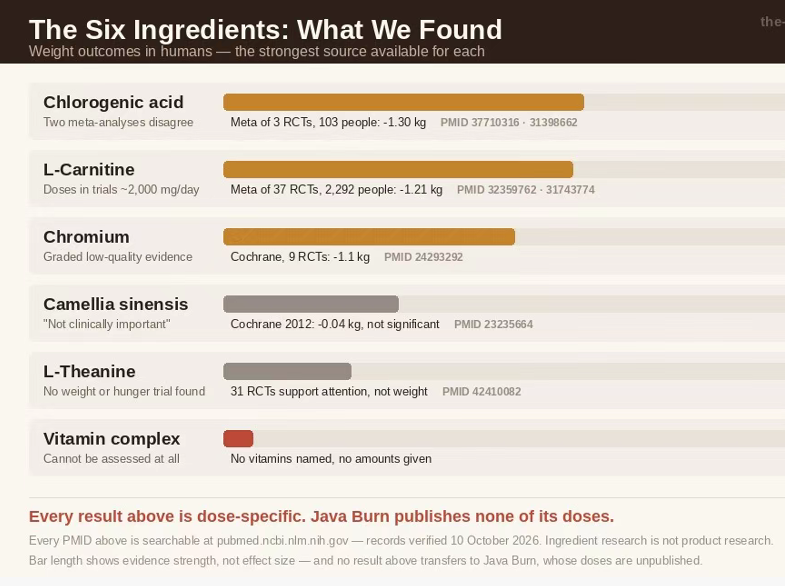
The label lists six groups: chlorogenic acid, Camellia sinensis, chromium, L-carnitine, L-theanine, and a “vitamin complex.” Here is what the research actually says about each, and how strong it is.
Chlorogenic acid. A 2023 systematic review pooled three randomised trials with 103 participants testing green bean coffee extract providing at least 500 mg/day of chlorogenic acid. Body weight fell by a weighted mean difference of −1.30 kg (95% CI −2.07 to −0.52, p = 0.001). But an earlier dose-response meta-analysis covering 16 randomised trials found a significant BMI reduction (−0.403 kg/m², p = 0.047) and no significant change in body weight (−0.585 kg, p = 0.210). Both are real. Anyone quoting only the first is giving you half the picture.
Camellia sinensis is the tea plant, but the label does not specify whether the extract is decaffeinated or how much caffeine it contains. We therefore cannot determine how much, if any, caffeine this ingredient contributes to the finished product. The most rigorous assessment we found is a Cochrane review of green tea preparations: pooling six studies conducted outside Japan, the mean difference in weight loss was −0.04 kg (95% CI −0.5 to 0.4; P = 0.88; 532 participants). That is indistinguishable from no effect.
Chromium is the second ingredient here with a Cochrane review behind it. A 2013 review evaluated nine randomised trials with 622 participants across doses of 200, 400, 500 and 1000 µg. Pooled effect on body weight: −1.1 kg (95% CI −1.7 to −0.4; P = 0.001). The reviewers graded the evidence low quality and said no reliable conclusion could be drawn.
L-carnitine has the largest evidence base in this formula. A 2020 meta-analysis pooled 37 randomised trials with 2,292 participants: body weight −1.21 kg (95% CI −1.73 to −0.68), BMI −0.24 kg/m², fat mass −2.08 kg. Three details narrow that considerably: no significant effect on waist circumference or body fat percentage; when restricted to high-quality trials, only the weight result held up; and the dose-response analysis points to 2,000 mg/day as the dose associated with maximum effect.
L-theanine. A 2026 meta-analysis pooled 31 randomised trials with 1,168 participants. A single 200 mg dose improved choice reaction time (SMD 0.51; 95% CI 0.25 to 0.77). The reduction in acute stress was smaller and largely driven by low-quality studies. This is an attention effect, not a weight effect.
Vitamin complex. No amounts, no forms, and no claim we could test.
What the Evidence Actually Supports
Some meta-analyses have reported small weight changes for certain ingredients under specific study conditions: chlorogenic acid (where two meta-analyses disagree on significance), L-carnitine (where only the weight result survives removal of low-quality trials), and chromium (where the reviewers themselves graded the evidence low quality). The evidence therefore varies in quality, and these results cannot be used to estimate the weight-loss effect of Java Burn, because its ingredient doses are not disclosed. Green tea — the ingredient with the most rigorous assessment of all — showed −0.04 kg, which is indistinguishable from no effect.
One study is closer to this product’s actual proposition than anything else we found: a randomised, double-blind, placebo-controlled crossover trial in 11 healthy men testing green tea catechins and coffee chlorogenic acids together — 620 mg catechins, 373 mg chlorogenic acids and 119 mg caffeine daily for three weeks, against a caffeine-matched placebo. Eleven men, three weeks. That is the entire evidence base for “these two things together in coffee.”
And there is a hierarchy worth keeping straight. Ingredient research asks whether a substance does something. Dose matching asks whether the product contains the amount that was studied. A finished-product trial asks whether this specific product does anything. Java Burn has the first, fails the second, and has never attempted the third.
The Dosage Problem
Not one of the six ingredient groups has a published amount. This is the single biggest gap in the product, because it makes every citation above unusable.
The chlorogenic acid meta-analysis was specifically of extracts providing at least 500 mg/day. The L-theanine finding was specifically for a 200 mg dose. The chromium review spanned 200 to 1000 µg and found no dose gradient. The L-carnitine trials typically use around 2,000 mg daily — and L-carnitine is the clearest illustration of why this matters, because a single-serve powder packet is a small container. Under US labelling rules (21 CFR 101.36), a proprietary blend may legally disclose only the total blend weight, with ingredients listed in descending order by weight. So the omission is permitted. It is also the reason no claim about this product can be checked.
Benefits and Limitations
What is in its favour. Some meta-analyses have reported small weight changes for certain ingredients under specific study conditions, though the evidence varies in quality. The advertised 60-day refund states that empty pouches are accepted — though the terms page on the same domain says the opposite, and we verified the published wording only. And coffee itself is not an ineffective vehicle — it already contains caffeine and chlorogenic acids, and roasting reduces but does not eliminate the latter.
What is not. No trial of the finished product exists, yet the page calls the formula “scientifically proven.” No doses are published. The central “synergy” claim — that adding this blend to coffee produces something neither produces alone — has no test behind it. And the metabolism story underneath the whole pitch has no source: the page states that “up to 80% of Americans may have simply inherited a slow and inefficient metabolism to some degree,” attributes it to 2023 research by “a team of scientific researchers” who studied “over 170 years of scientific data,” and names no researchers, no institution and no publication. We could not find such a study.
Side Effects and Safety
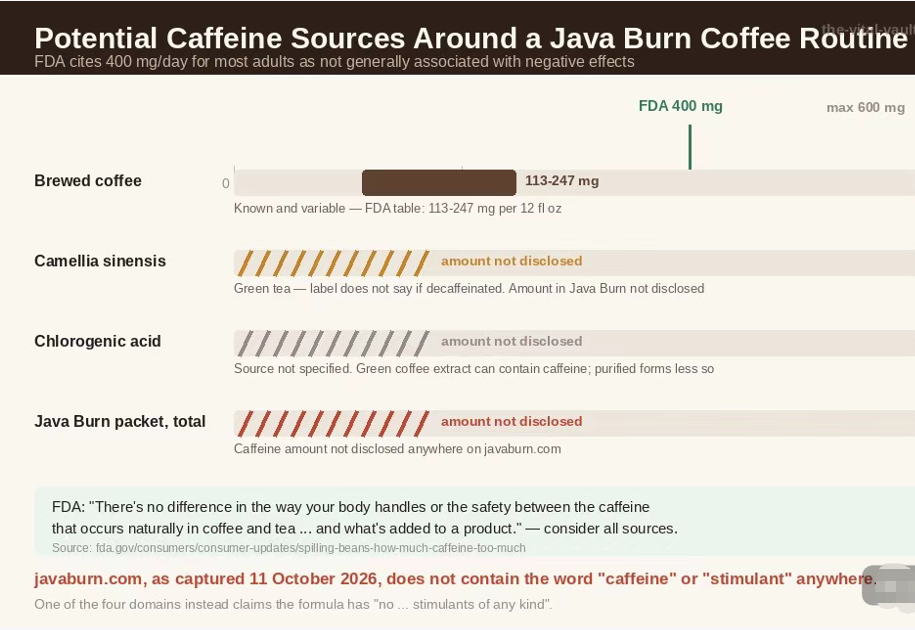
The product does not disclose its caffeine content. Camellia sinensis is the tea plant, but the label does not state whether that extract is decaffeinated or how much caffeine it contributes. The product also lists chlorogenic acid without saying whether it comes from a caffeine-containing green coffee extract or a purified source. No caffeine figure is disclosed anywhere. The FDA cites 400 mg/day for most adults as “an amount not generally associated with negative effects,” and puts regular brewed coffee at 113 to 247 mg per 12 fl oz — a wide range, meaning one large mug can already account for well over half that reference point. You are adding an unknown amount on top.
Green tea extracts and liver injury. The US Pharmacopeia’s hepatotoxicity expert panel found published case reports associating hepatotoxicity with EGCG intakes from 140 mg to about 1,000 mg/day. The trial side is more reassuring: a systematic review of 34 randomised trials of green tea extracts found liver-related adverse events reported in only four, with a summary odds ratio of 2.1 (95% CI 0.5 to 9.8) — not statistically significant. Both are worth knowing, and neither can be applied to Java Burn specifically, because we do not know how much green tea it contains.
On “FDA approved.” The FDA does not approve dietary supplements for safety or effectiveness before they are sold. What exists is facility registration and GMP requirements — registration is not approval, certification or endorsement. Four domains handle this differently, and we found none of them fully accurate (see below).
Price, Domains and Refund Terms
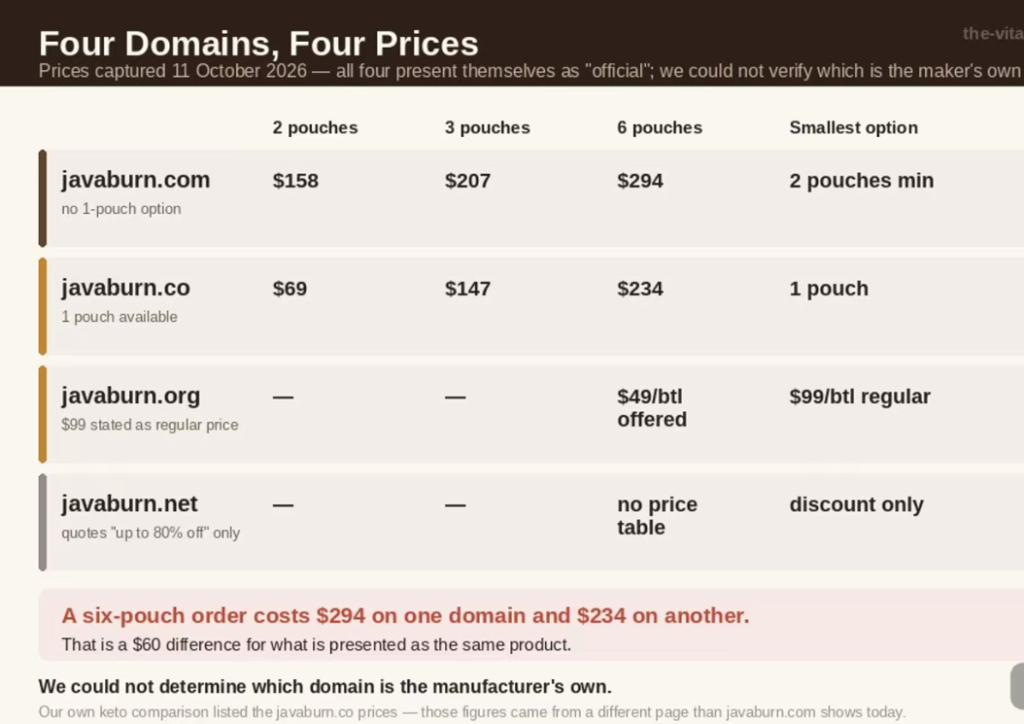
Prices below come from the page our affiliate link reaches, javaburn.co, captured 11 October 2026:
| Package | Total | Per pouch | Cost per day | Shipping |
|---|---|---|---|---|
| 1 pouch (30 days) | $69 | $69 | $2.30 | Added at checkout |
| 3 pouches (90 days) | $147 | $49 | $1.63 | Added at checkout |
| 6 pouches (180 days) | $234 | $39 | $1.30 | Free |
At the six-pouch rate that is roughly $475 a year. The refund window is 60 days from purchase, and the guarantee is described in more than one place — the descriptions do not agree.
The FAQ block on javaburn.co says you may “return the product, even empty pouches” for a “full, no questions asked refund (less shipping and handling).” The terms page on the same domain is stricter: “all items must be returned undamaged,” “returned items and return shipping costs are your responsibility,” and “any items that are damaged when we receive them will not be eligible for refund.” An empty pouch is not an undamaged one, so those two statements cannot both describe the same return. A third version appears in the sales letter, which says there is “simply no risk to you” and does not mention a deduction at all. “Handling” is not defined in any of them, and we verified the published wording, not whether refunds are consistently honoured.
One more thing about timing. The FAQ advises that “research shows it’s best to take Java Burn consistently for at least 90 – 180 days” and that buying “at least 90 -180 days worth is definitely the smart option.” The refund window is 60 days. The course of use the page recommends therefore runs 30 to 120 days past the point at which a refund is still available. That is a trade-off between cost per day and refund coverage, not a recommendation from us, and it is not evidence that a larger package produces a better result.
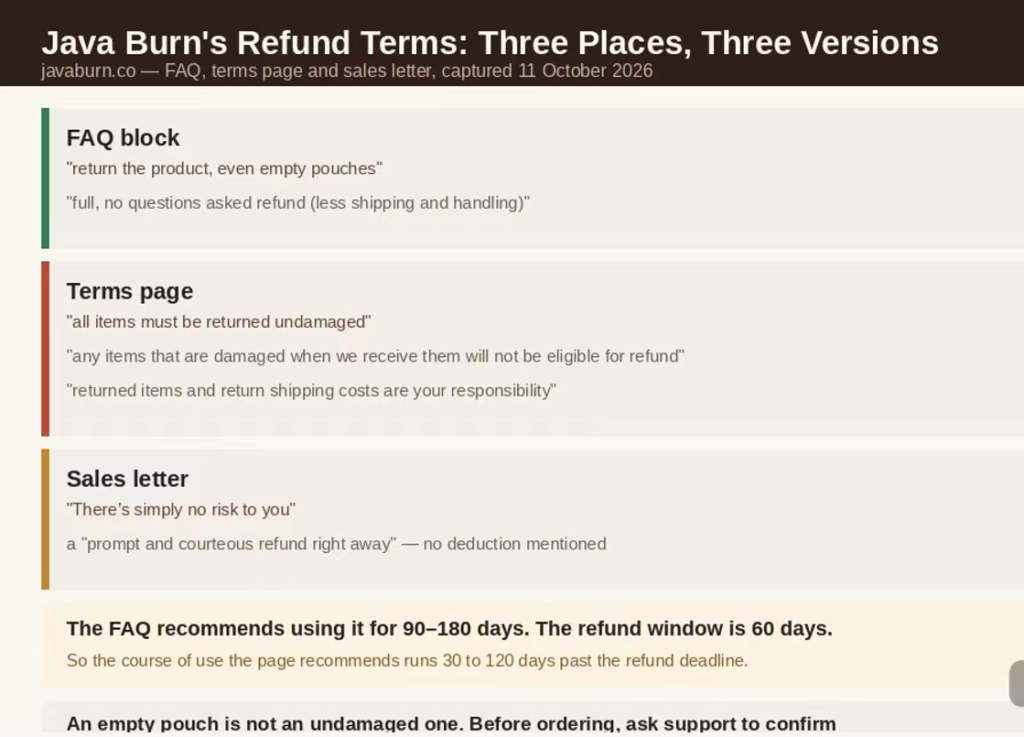
Now the part that matters. At least four domains sell this product, each presenting itself as the official site, with different prices and different FDA wording:
| Domain | Packages and prices shown | FDA wording used |
|---|---|---|
| javaburn.com | 2 pouches $158 ($79/pouch) · 3 pouches $207 ($69/pouch) · 6 pouches $294 ($49/pouch, free shipping) | “FDA approved and GMP certified facility” |
| javaburn.co | 1 pouch $69 · 3 pouches $147 ($49/pouch) · 6 pouches $234 ($39/pouch) | “FDA approved and GMP certified” |
| javaburn.org | Regular $99/bottle, offered at $49/bottle; “Save Up To $894” | “FDA registered facility” — more careful wording, but its own heading reads “FDA Approved Facility” and the body says it “adheres to strict FDA regulations” |
| javaburn.net | No price table; “Up To 80% Off Today + Free Shipping + 60 Day Money Back Guarantee” | “FDA-approved and GMP-certified facilities,” while its own FAQ states supplements are not typically FDA approved |
On a six-pouch order, the same product is $234 on one domain and $294 on another — a $60 difference with no explanation. We could not verify which, if any, is the maker’s own site.
Two further observations from the same capture. First, javaburn.com and javaburn.co display the same reference prices — $591 for three pouches, $1,182 for six — while charging $207 and $294 against one and $147 and $234 against the other. So one “original” price produces a claimed saving of $384 on one page and $444 on another. That is not a discount that varies with the product; it is a reference point that stays still while the price moves. Second, the sales letter on javaburn.co tells the reader, “Right now, today, you can get a 30-day supply of Java Burn for a simple, one-time fee of just $49” — while the order form on the same page prices a 30-day supply, one pouch, at $69.
Pros and Cons
Pros
- 60-day refund advertised, with the FAQ stating empty pouches are accepted (published wording only; shipping and handling deducted)
- Some meta-analyses report small weight changes for certain ingredients under specific study conditions
- Six-pouch pricing brings the daily cost down to $1.30
Cons
- No trial of the finished product, despite the “scientifically proven” claim
- No published dose for any of the six ingredient groups
- Caffeine content not disclosed, on top of what is already in your coffee
- Four domains, four prices, no verifiable official source
- Reference prices stay fixed while the selling price changes
- Refund is “less shipping and handling,” with “handling” undefined
- Refund terms conflict: FAQ accepts empty pouches, the terms page requires items returned undamaged, and the sales letter says “no risk to you”
Who It May Suit, and Who It Should Skip
May suit: someone already drinking coffee daily, comfortable spending $1.30 to $2.30 a day on an unproven additive, who understands they are buying ingredient-level evidence with no dose confirmation. To be explicit about what that evidence does and does not do: the meta-analyses above are not a reason to buy Java Burn. They describe specific doses of specific preparations, and this product publishes neither.
Should skip: anyone sensitive to caffeine, since the amount is undisclosed and sits on top of a 113–247 mg cup; anyone with liver conditions or taking medication, given the green tea extract case reports; pregnant or breastfeeding women; and anyone on a fixed budget who would feel a $69 to $234 loss — because the advertised refund is not a full one — shipping and handling are deducted, and return postage is your cost.
Final Verdict
Java Burn sells a plausible idea with an untested product. The ingredients are not fake — chlorogenic acid, L-carnitine and chromium have each been studied for possible weight effects. But those studies measured specific doses in specific preparations, and this product does not tell you any of its doses. That single omission means the published findings cannot be used to estimate what Java Burn itself would do.
The undisclosed caffeine content, inconsistent pricing across sales domains, and lack of a verified manufacturer add further uncertainty. We do not recommend one package over another: a larger supply costs less per pouch and extends use beyond the 60-day refund window, which is a trade-off between cost per day and refund coverage rather than evidence that it works better. Anyone considering the product should verify the seller, read the refund terms in both places they appear — the FAQ says empty pouches are accepted, the terms page says items must be returned undamaged — and weigh the cost against the absence of direct evidence for the finished formula. current Java Burn pricing is on the official site.
Frequently Asked Questions
Does Java Burn actually work for weight loss?
We found no trial of Java Burn itself, so there is no direct answer. Some meta-analyses have reported small weight changes for certain ingredients under specific study conditions, though the evidence varies in quality. The most rigorous review of another ingredient, green tea, found weight loss that was not statistically significant. And because no doses are published, none of that research can be matched to what is in the packet.
How much caffeine is in Java Burn?
The product does not say, and we could not determine it. One named ingredient, Camellia sinensis, is the tea plant, but the label does not state whether that extract is decaffeinated or how much caffeine it contributes. The product also lists chlorogenic acid without specifying whether it comes from a caffeine-containing green coffee extract. The FDA cites 400 mg/day for most adults as not generally associated with negative effects, and puts brewed coffee at 113 to 247 mg per 12 fl oz.
Is Java Burn FDA approved?
No — and no dietary supplement is. The FDA does not approve supplements for safety or effectiveness before they are marketed. What exists is facility registration and GMP compliance, which is not approval. javaburn.org uses the more careful phrase “FDA registered facility,” but the same page’s heading reads “FDA Approved Facility” and its body says the product “adheres to strict FDA regulations.”
Why do different websites show different prices?
Because at least four domains sell this product, each presenting itself as the official site, with different prices. On six pouches we saw $234 on one and $294 on another. We could not verify which domain, if any, is the maker’s own. Prices also change; ours is a snapshot from 11 October 2026.
Can I take it with tea instead of coffee?
The product is designed for coffee and the pitch depends on coffee as a “primer.” Nothing on the pages addresses tea. Given that one ingredient is the tea plant and caffeine is undisclosed, adding it to tea would mean an even less predictable caffeine total.
What does “less shipping and handling” actually cost me?
The page does not define it. It means your refund will be reduced by an amount that is not disclosed before you buy, and the terms page adds that “returned items and return shipping costs are your responsibility.” Before ordering, ask customer support to confirm the applicable return procedure, whether empty pouches qualify, and what the shipping and handling deduction will be — in writing.
If you decide to try it, buy from the page you can verify. Four domains present themselves as official, and we could not confirm which is the maker’s own. Check the price on the order form itself before you pay: the sales letter and the order form on the same page have quoted two different figures for a 30-day supply. Check current Java Burn pricing on the official site.
Sources
Kanchanasurakit S, et al. Chlorogenic acid in green bean coffee on body weight: a systematic review and meta-analysis of randomized controlled trials. Syst Rev. 2023;12(1):163. PMID 37710316.
Gorji Z, et al. The effect of green-coffee extract supplementation on obesity: a systematic review and dose-response meta-analysis. Phytomedicine. 2019;63:153018. PMID 31398662.
Jurgens TM, et al. Green tea for weight loss and weight maintenance in overweight or obese adults. Cochrane Database Syst Rev. 2012;(12):CD008650. PMID 23235664.
Tian H, et al. Chromium picolinate supplementation for overweight or obese adults. Cochrane Database Syst Rev. 2013;(11):CD010063. PMID 24293292.
Talenezhad N, et al. Effects of l-carnitine supplementation on weight loss and body composition: a systematic review and meta-analysis of 37 randomized controlled trials with dose-response analysis. Clin Nutr ESPEN. 2020;37:9–23. PMID 32359762.
Askarpour M, et al. Beneficial effects of l-carnitine supplementation for weight management in overweight and obese adults. Pharmacol Res. 2020;151:104554. PMID 31743774.
Gerolymos C, et al. Cognitive and affective effects of L-theanine: a systematic review and meta-analysis of 31 randomized trials. Mol Psychiatry. 2026 Jul 6. DOI: 10.1038/s41380-026-03727-9. PMID 42410082.
Yanagimoto A, et al. Effects of ingesting both catechins and chlorogenic acids on glucose, incretin, and insulin sensitivity in healthy men: a randomized, double-blinded, placebo-controlled crossover trial. Nutrients. 2022;14(23):5063. PMID 36501092.
Oketch-Rabah HA, et al. United States Pharmacopeia comprehensive review of the hepatotoxicity of green tea extracts. Toxicol Rep. 2020;7:386–402. PMID 32140423.
Isomura T, et al. Liver-related safety assessment of green tea extracts in humans: a systematic review of randomized controlled trials. Eur J Clin Nutr. 2016;70(11):1221–1229. PMID 27188915.
U.S. Food and Drug Administration. Spilling the Beans: How Much Caffeine is Too Much?. fda.gov.
U.S. Food and Drug Administration. Information for Consumers on Using Dietary Supplements. fda.gov — including the statement that FDA is not authorised to approve dietary supplements for safety and effectiveness before they are marketed.
U.S. Food and Drug Administration. 21 CFR 101.36 — nutrition labelling of dietary supplements, proprietary blend provisions. ecfr.gov.
Java Burn sales page, FAQ and terms page, javaburn.com, captured 11 October 2026. Java Burn pages at javaburn.net, javaburn.org and javaburn.co, captured 11 October 2026.
Related Reading
5 Best Keto Supplements in 2026: Tested, Ranked & Honest — where Java Burn placed among the keto supplements we compared, and how its pricing compares to the others on that list.
LeanBliss Review 2026: Does This Chocolate Weight Loss Supplement Work? — another weight-loss supplement reviewed with the same method, including the same dose-transparency check.
Ketosis Advanced Review 2026 — our assessment of a BHB ketone supplement, for readers comparing weight-loss approaches.
Java Burn review 2026 — last updated on 11 October 2026. Product pricing and policies change frequently; always verify the terms on the page where you buy. This article contains affiliate links. Cedric Hale is the byline used by the editorial team behind The Vital Vault.