Disclosure: this article contains affiliate links, and we may earn a commission if you buy through them. It does not change what we found below. Cedric Hale is the byline used by the editorial team behind The Vital Vault.
Gluco6 is a once-daily capsule sold on a single official page, built on one idea: that your cells’ sugar gateways (GLUT-4 receptors) have worn out, and that a “different kind of sugar” called Sukre can reopen them. The page says it is “backed by Harvard research” and has “already” been dropping A1C “by up to 2.8 points in 90 days.”
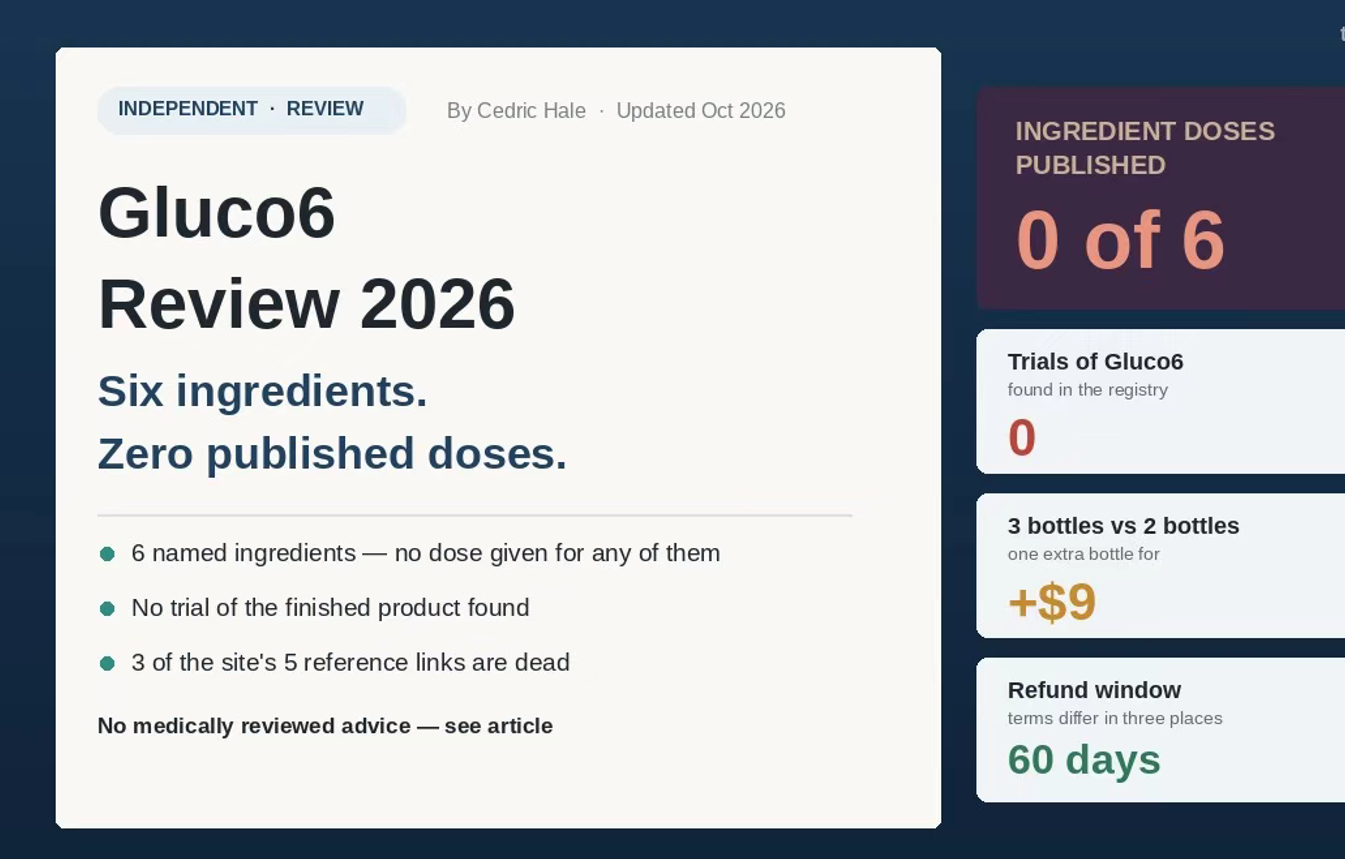
Three things matter most. No dose is published for any of the six ingredients, so none of the research below can be connected to this product. The page never defines Sukre — but its own references are almost all studies of L-arabinose, which makes that a plausible candidate rather than a confirmed identity, and they describe a different mechanism from the one the page claims. And three of the five links in the site’s own “Scientific References” list are dead, one of them misspelled.
The ingredients are not nonsense — gymnema and cinnamon have real human meta-analyses behind them, one better than we expected. But the headline claims rest on a rat study, a 15-man trial, and a number we could not trace to any source.
Table of Contents
What Gluco6 Is and What It Claims
Gluco6 is a capsule — one per day, before breakfast, sold only through its own site, with ClickBank named as the retailer of record.
The header adds two claims we test below: that the formula is “backed by Harvard research,” and that it has “already” been “dropping A1C by up to 2.8 points in 90 days.”
The Six Ingredients — None With a Published Dose
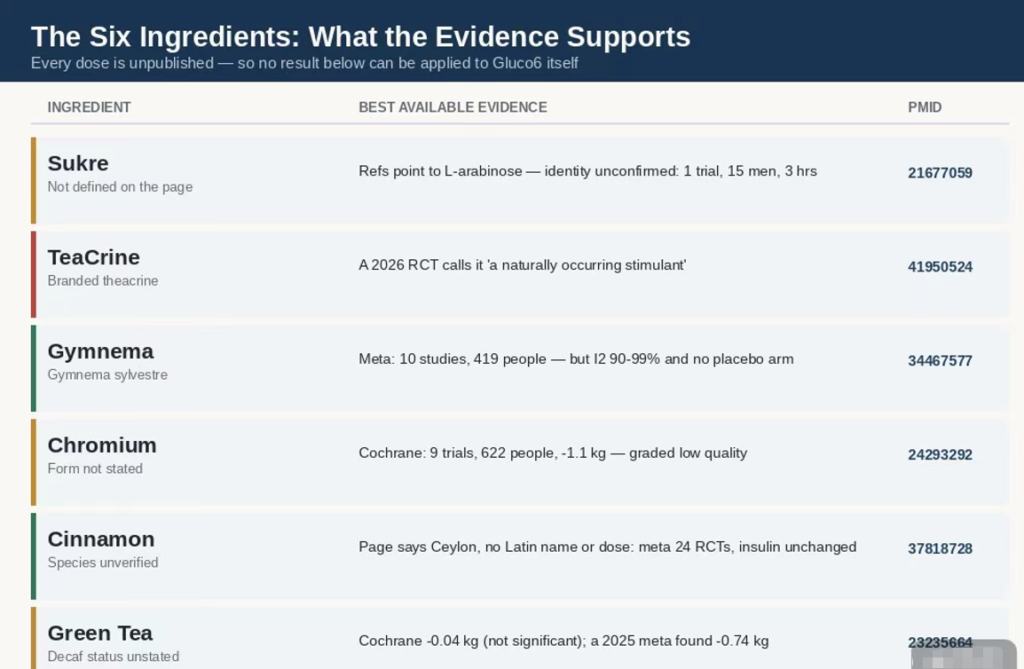
The page names six ingredients: Sukre, TeaCrine, Gymnema, Chromium, Cinnamon and Green Tea. It publishes no milligram amounts, no blend total and no supplement facts panel. That is the most consequential fact about this product.
Sukre: the ingredient the page never defines
Sukre is “a natural prebiotic sugar” that “takes pressure off your GLUT-4 receptors.” That is the whole definition: no compound, no source, no amount.
We did not have to guess at the mechanism, though we did have to stop short of an identification. The page’s own references are studies of L-arabinose, a low-calorie sugar that inhibits intestinal sucrase, the enzyme that splits table sugar into glucose and fructose. This makes L-arabinose a plausible candidate for what the page calls Sukre, but the manufacturer does not identify Sukre’s chemical composition. Without that disclosure, we cannot confirm that those studies describe the ingredient actually used in Gluco6.
Why the mechanism matters either way: if Sukre is L-arabinose, it works by slowing the digestion of sucrose you have just eaten — not by acting on GLUT-4 receptors, and only when sucrose is present.
TeaCrine
TeaCrine is a branded form of theacrine. The page’s six badges include “No Stimulants” — which sits oddly with a formula that also contains green tea. We return to this below.
Gymnema, chromium and cinnamon: real evidence, no amounts
Gymnema sylvestre has the strongest human signal. A 2021 meta-analysis pooled 10 studies with 419 participants with type 2 diabetes and reported significant reductions in fasting glucose, postprandial glucose and HbA1c. Two caveats: heterogeneity was extreme (I² 90–99%), and the analysis compared post-intervention values with baseline rather than placebo. Both inflate apparent effects.
Cinnamon. The page says it uses “concentrated Ceylon cinnamon,” but gives no Latin name, no extract standardisation and no dose, so we cannot verify which species or preparation is in the capsule. That gap is not academic: cassia cinnamon can contain considerably more coumarin than Ceylon, which matters for prolonged daily use. Research has examined cinnamon supplements for glycaemic control generally — a 2024 dose-response meta-analysis of 24 randomised trials found significant reductions in fasting blood sugar and HbA1c, but no significant change in fasting insulin (p = 0.058) — but none of it can be matched to an unverified ingredient at an unknown dose.
Chromium has a Cochrane review: nine trials, 622 participants, 200–1,000 µg; weight −1.1 kg (95% CI −1.7 to −0.4; P = 0.001), graded low quality with no reliable conclusion. Note that the outcome reported here is weight, not blood sugar, so it says little about the claim Gluco6 is selling. The FAQ warns against other high-chromium formulas, which implies a meaningful amount — without saying how much.
Green tea
The most rigorous assessment is a Cochrane review: six studies outside Japan, mean difference in weight loss −0.04 kg (95% CI −0.5 to 0.4; P = 0.88; 532 participants) — indistinguishable from no effect. Again, this measures weight loss, not blood glucose or A1C.
That is not the only verdict. A 2025 GRADE-assessed meta-analysis with broader criteria found −0.74 kg (95% CI −0.97 to −0.51), with smaller drops in BMI and waist circumference. Both are real; they differ in which trials they accepted. Neither applies to Gluco6, because neither the amount nor the caffeine content is published.
What the Research Behind Sukre Actually Shows
Because Sukre is undefined, we assessed the compound its own references point to: two human studies and one animal study.
The human trial: 15 men, one sugary drink
The strongest is a randomised, double-blind, crossover trial in The American Journal of Clinical Nutrition (PMID 21677059): 15 healthy men drank a beverage containing 75 g of sucrose with 0%, 1.3%, 2.7% or 4% L-arabinose by weight.
At 4%, the glucose peak was 11% lower, the insulin peak 33% lower and delayed, insulin incremental AUC 23% lower, and GLP-1 incremental AUC 53% higher. Real acute effects.
Three caveats. It was 15 men, one drink, a three-hour window. The effect required sucrose — sucrase inhibition does nothing without substrate. And it found no effect on appetite, energy intake at lunch, or triglycerides: the study closest to Gluco6’s own mechanism found no change in how much participants then ate. An earlier study reported similar acute findings in three small groups, always with a sucrose load.
Where the GLUT-4 story comes from: rats
The GLUT-4 framing comes from a 2015 study in Food & Nutrition Research: rats with diet-induced metabolic syndrome given L-arabinose by gavage for six weeks showed lower body weight, blood pressure, fasting glucose, triglycerides, cholesterol, insulin, TNF-α and leptin, plus changes in hepatic gene expression including GLUT4.
It is a competent animal study and the authors are measured about it. It is also the only source measuring outcomes like the ones the sales page describes. A six-week gavage study in rats is not evidence about A1C in humans taking a capsule.
The A1C Claim We Could Not Trace
The header says Gluco6 has “already” been “dropping A1C by up to 2.8 points in 90 days.” We could not find a source for that figure.
None of the five references measures A1C in humans. The two human studies measured post-meal glucose and insulin over three hours; the rat study measured HbA1c — in rats. There is no trial of Gluco6 itself: we searched ClinicalTrials.gov and PubMed and found none.
“Up to” is doing a lot of work — it is compatible with an average of zero if one person had a large change. And the other results on the page — 29 lbs lost, A1C from 8.1 to 5.9, from 7.8 to 5.4 — are testimonials, which the page’s own footer says “are not intended to represent or guarantee that anyone will achieve the same or similar results.”
On “backed by Harvard research”: no study, author or institution is named. We report it as unverified rather than false, because a claim that unspecific cannot be checked.
“No Stimulants” vs TeaCrine and Green Tea
The page’s six badges are Natural Formula, Plant Ingredients, Non-GMO, Easy to Swallow, No Stimulants, and Non-Habit Forming. The formula contains TeaCrine (theacrine) and green tea.
A 2026 randomised, double-blind crossover study in 19 healthy adults (PMID 41950524) opens by calling theacrine “a naturally occurring stimulant” and tested 3, 6 and 9 mg/kg; higher doses raised salivary cortisol at 120 and 180 minutes versus placebo — though subjective energy improved only with placebo. A 2024 dose-response study examined theacrine’s effects on cognition and subsequent sleep, framed explicitly around psychostimulants.
None of this makes theacrine dangerous. It does make the badge inaccurate if it means what a reader would take it to mean — and the page does not say whether the green tea is decaffeinated or how much caffeine it contributes. If you are caffeine-sensitive, or take medication affected by food timing, that is a question for a pharmacist.
The Reference List: Three of Five Links Do Not Work
The page ends with a “Scientific References” section of five links. We checked each on 11 October 2026.
| Reference as listed | What it actually is | Status |
|---|---|---|
| jstage 53_6_243 | L-arabinose, human sucrose-loading study, 2000 | Live |
| PMC4676841 | L-arabinose, rat metabolic syndrome study, 2015 | Live |
| academic.oup.com/ajcn/94/2/472 | L-arabinose, 15-man RCT, Am J Clin Nutr 2011 | Link 404; study exists (PMID 21677059) |
| academic.oup.com/ajen/94/2/472 | Duplicate of the above, misspelled journal code | 404 |
| jstage 53_6_243/article5 | — | 404 |
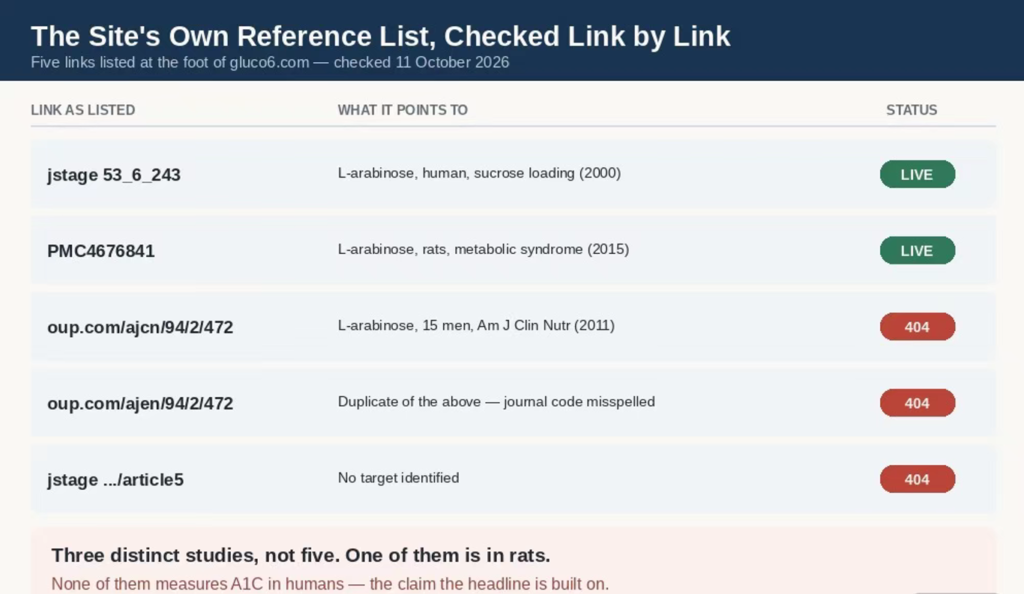
In short, three of the five links are dead, and the five links point to only three distinct studies, one of them in rats. Two of the dead links are a misspelled duplicate and a malformed variant of other entries; the third is the 2011 trial, whose study exists but whose listed link no longer loads. Not a fatal flaw — but a page that asks you to trust its science should maintain the citations it offers.
Price and Packages
| Package | Supply | Per bottle | Total | Cost per day |
|---|---|---|---|---|
| 2 bottles | 60 days | $69 | $138 | $2.30 |
| 3 bottles | 90 days | $49 | $147 | $1.63 |
| 6 bottles | 180 days | $39 | $234 | $1.30 |
All three include free US shipping; the three- and six-bottle packages add two digital bonuses. Prices captured 11 October 2026. Current packages are on the official Gluco6 page.
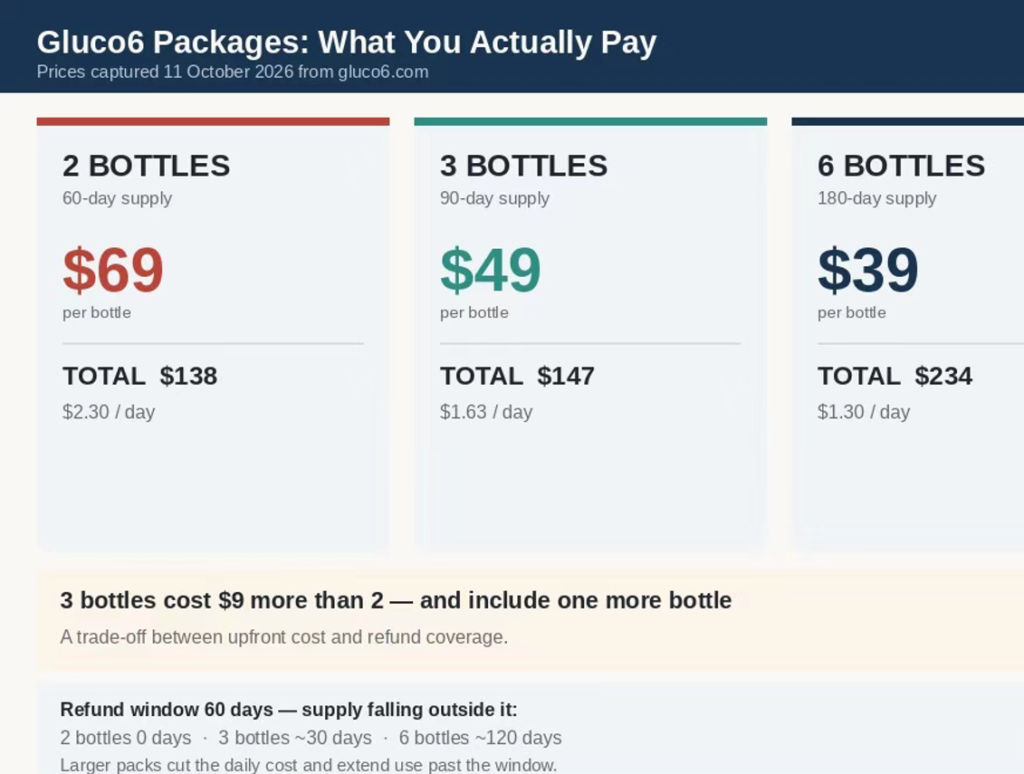
Note that the pricing is not linear: three bottles cost $9 more than two, for an extra bottle. The two-bottle package has the highest per-bottle price, but its 60-day supply aligns with the advertised 60-day refund window. Larger packages lower the daily cost while extending the period of use beyond it — three bottles is 90 days of supply and six is 180. The FAQ recommends three to six months of use and promotes the six-bottle option, a timeline that runs well past the point at which a refund is still available. This is a trade-off between upfront cost and refund coverage, not proof that any package offers better results.
The Refund Policy: Read the Actual Page
The page advertises a 60-day guarantee and states it twice, with different terms each time.
| Where it appears | What it says |
|---|---|
| Guarantee section | “return any unused bottles and cover a minimal shipping cost” |
| FAQ | “just return the bottles (even if empty) … less shipping and handling fees” |
The first implies unopened bottles; the second explicitly allows empty ones. Both deduct an unspecified shipping or handling amount, so the sales page alone does not settle which applies.
Two further pages complicate this. The footer link marked “Return Policy” points to gluco6.com/shipping-returns/, which is complete: a return address in Aurora, Colorado, a support phone number, a 60-day money-back guarantee covering opened and unopened bottles, a seven-working-day processing time, and return shipping paid by the buyer. That is the page we would rely on. A second page at gluco6.com/refund-policy also loads, but it is an unfilled BuyGoods template addressed to the vendor (“Please provide the return address, returning instructions, and support email and phone number to your Business Development Manager”), with a “Copyright 2023” footer. We read it as an uncleaned page left on the site, not as evidence that a refund cannot be obtained.
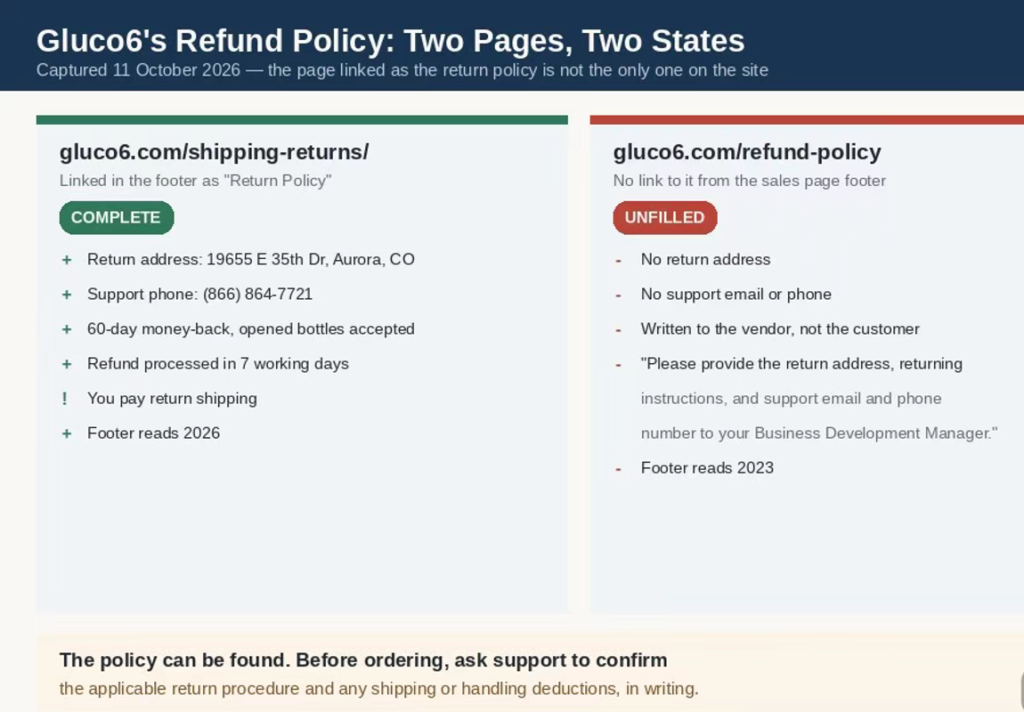
One difference remains: the FAQ promises a refund “less shipping and handling fees,” while the policy page mentions return shipping but no handling fee. We did not test whether refunds are honoured, and the guarantee’s condition — that Gluco6 must “significantly boost your energy and reduce blood sugar spikes within 60 days” — is subjective enough that only the seller can say how it is applied. Before ordering, ask customer support to confirm the return procedure and any deductions in writing.
What “FDA-Registered” Means — and Does Not
The FAQ says Gluco6 is “manufactured in the USA at our FDA-registered and GMP-certified facility” and “undergoes additional third-party inspections.”
An FDA-registered facility is one that has registered. It is not approval of anything made there: the FDA states that it is not authorised to approve dietary supplements for safety and effectiveness before they are marketed. The page’s own footer carries the required disclaimer, including that the product is “not intended to diagnose, treat, cure or prevent any disease.”
Third-party testing is claimed, but no certificate of analysis, laboratory or batch number is published — common in this category, and it means the claim cannot be checked. The FAQ also says there have been “no reported side effects”; without published post-market surveillance, absent reports are not absent effects. Its advice to consult a doctor and keep taking prescribed medication is right, and worth following.
What We Could Not Verify
- Sukre’s identity and amount — chemical composition never disclosed, so the L-arabinose research cannot be confirmed as relevant to this product.
- The cinnamon species — the page says Ceylon, but gives no Latin name or extract standard.
- Every other dose — no amounts for TeaCrine, gymnema, chromium, cinnamon or green tea.
- “Backed by Harvard research” — no study, author or department named.
- “A1C down up to 2.8 points” — not traceable to anything in the reference list.
- “Dr. Leavitt” — quoted recommending three to six months of use; no full name, credentials or link.
- Whether refunds are honoured — we read the policy; we did not test it.
- Caffeine content — green tea listed with no indication of whether it is decaffeinated.
Who Might Consider It, and Who Should Not
We want to be careful here, because it is easy to read the ingredient research above as a reason to buy. It is not one. The L-arabinose trial we described is real, but Gluco6 itself has not been tested in humans, Sukre’s chemical identity is not disclosed, and no dose is published for any ingredient. Ingredient research tells you what a substance did, at a known dose, in a defined population — it does not tell you what an untested product containing an undisclosed amount of it will do.
That distinction matters most for anyone with diabetes or prediabetes. Gluco6 is a supplement, not a treatment: the page’s own disclaimer says it is not intended to diagnose, treat, cure or prevent any disease. Nothing in this review should be read as a reason to start, stop or change any prescribed medication. If you take glucose-lowering medication, speak to your doctor or pharmacist first — cinnamon, chromium and gymnema can all affect blood glucose, which is exactly why combining them with medication is a question for a clinician rather than a product page.
Speak to a clinician first, or skip it, if you are pregnant, nursing, or managing a diagnosed condition. Think carefully if you are caffeine-sensitive. And if your decision depends on the guarantee, resolve the shipping-and-handling deduction before you order.
How Gluco6 Compares
| Product | Named ingredients | Doses? | Refund |
|---|---|---|---|
| Gluco6 | 6 — Sukre, TeaCrine, gymnema, chromium, cinnamon, green tea | No | 60 days |
| Sugar Defender | Gymnema, chromium, Korean red ginseng, maca, guarana | No | 60 days |
| GlucoTrust | Biotin, chromium, manganese, zinc, gymnema, licorice, cinnamon | No | 180 days |
Across every product we have reviewed here, ingredient doses remain the largest transparency gap. Price and refund terms matter to a purchase, but they cannot establish effectiveness or product quality, and neither can a longer guarantee. Without disclosed doses, confirmed ingredient identities and product-specific clinical evidence, we cannot determine which formula offers the best clinical value — and we would be wary of any review that claims to.
Frequently Asked Questions
Does Gluco6 actually lower A1C?
No published study of Gluco6 measures A1C. The header claim is not supported by anything in the reference list; the two human studies behind its main ingredient measured blood glucose over three hours after a sugary drink.
What is Sukre?
The page does not define it beyond “a natural prebiotic sugar.” Its own references are L-arabinose studies, making that a plausible candidate — but the chemical composition is never stated, and no dose is given.
Is Gluco6 stimulant-free?
The page displays a “No Stimulants” badge, but the formula contains TeaCrine and green tea. A 2026 study calls theacrine “a naturally occurring stimulant,” and the tea’s caffeine content is not stated. We would not rely on the badge.
Which package should I buy?
We do not recommend one. The two-bottle package has the highest per-bottle price, but it is the only one whose supply fits inside the 60-day refund window; see the Price and Packages section for the numbers.
Is Gluco6 FDA approved?
No dietary supplement is. The FDA is not authorised to approve supplements before they are marketed. “FDA-registered facility” means the facility registered, not that the product was evaluated.
Bottom Line
Gluco6 is better than some products in its category on the narrow measures we checked, and worse on others. Better: a short, named ingredient list, with genuine human meta-analyses behind gymnema and cinnamon. Worse: the headline claims are not traceable. The GLUT-4 narrative comes from a rat study, the A1C figure from nowhere we could find, three of five reference links are dead, and one of the two refund pages on the site is an unfilled vendor template. Undisclosed doses and an undefined key ingredient prevent any reliable product-level assessment, and the “No Stimulants” badge sits beside a formula containing theacrine and green tea.
We found no evidence of fraud, but this is a product whose marketing runs well ahead of its evidence, and we would not buy it on the strength of the page’s own numbers.
On buying: we are not recommending a package. If you do order, get the shipping-and-handling deduction in writing first. Current pricing is on the official Gluco6 page (affiliate link).
Sources
Inoue S, et al. Effect of L-arabinose on blood glucose level after ingestion of sucrose-containing food in human. J Jpn Soc Nutr Food Sci. 2000;53(6):243–247. DOI: 10.4327/jsnfs.53.243.
Krog-Mikkelsen I, et al. The effects of L-arabinose on intestinal sucrase activity: dose-response studies in vitro and in humans. Am J Clin Nutr. 2011;94(2):472–478. PMID 21677059.
Hao L, et al. Protective effects of L-arabinose in high-carbohydrate, high-fat diet-induced metabolic syndrome in rats. Food Nutr Res. 2015;59:28886. PMCID: PMC4676841.
Devangan S, et al. The effect of Gymnema sylvestre supplementation on glycemic control in type 2 diabetes patients: a systematic review and meta-analysis. Phytother Res. 2021;35(12):6802–6812. PMID 34467577.
Moridpour AH, et al. The effect of cinnamon supplementation on glycemic control in patients with type 2 diabetes mellitus: an updated systematic review and dose-response meta-analysis of randomized controlled trials. Phytother Res. 2024;38(1):117–130. PMID 37818728.
Tian H, et al. Chromium picolinate supplementation for overweight or obese adults. Cochrane Database Syst Rev. 2013;(11):CD010063. PMID 24293292.
Jurgens TM, et al. Green tea for weight loss and weight maintenance in overweight or obese adults. Cochrane Database Syst Rev. 2012;(12):CD008650. PMID 23235664.
Dehzad MJ, et al. Effects of green tea supplementation on obesity indices and adipokines in adults: a GRADE-assessed systematic review and dose-response meta-analysis of randomised controlled trials. Int J Food Sci Nutr. 2025;76(4):340–369. PMID 40326418.
Stoke C, et al. Assessing the impact of high theacrine doses on hemodynamic measures, cognitive performance, and physiological stress. Appl Physiol Nutr Metab. 2026;51:1–13. PMID 41950524.
Gardiner CL, et al. Dose response effects of theacrine on cognitive performance and subsequent sleep. Sci Rep. 2024;14(1):28614. PMID 39562624.
U.S. Food and Drug Administration. Information for Consumers on Using Dietary Supplements. fda.gov — including the statement that FDA is not authorised to approve dietary supplements for safety and effectiveness before they are marketed.
Gluco6 sales page, FAQ, terms, shipping-and-returns page and refund-policy page, gluco6.com, captured 11 October 2026.
Related Reading
5 Best Blood Sugar Supplements in 2026: Tested & Ranked — where Gluco6 placed among the products we compared.
Sugar Defender Review 2026 — reviewed with the same dose-transparency check.
Sugar Defender vs GlucoTrust: Which Is Better in 2026? — a head-to-head comparison of two products on our list.
This article was last updated on 11 October 2026. Product pricing and policies change frequently; always verify the terms on the page where you buy. Affiliate disclosure and byline note appear at the top of this article.